
Are You Not Entertained?
When you hear the word worship, what first comes to mind—and why?

In the movie Gladiator, the betrayed and battle-scarred Maximus fights in the arena in Rome to the cheers of a bloodthirsty crowd. He turns in sarcasm and shouts, "Are you not entertained?" The fickle audience roars for more violence. Rome had degenerated into a lazy, pleasure-seeking society. The movie portrays the emperor, Caesar Commodus, whose jealousy, insecurity, and cruelty led him to murder his father, Marcus Aurelius, to seize the Roman throne.
The arena has changed—but the crowd has not. The appetite for spectacle did not die with Rome; it followed us into the church.
In their book The Great Dechurching: Who's Leaving, Why Are They Going, and What Will It Take to Bring Them Back?, authors Michael Graham and Jim Davis state, "About 40 million Americans have left churches and other religious institutions in the last 25 years."
When you hear the word worship, what first comes to mind—and why?
While on vacation, my family attended a church service, and on the way out, one of the greeters asked, "Did you enjoy the service?" That question, though innocently posed, prompted me to reflect on the meaning of worship. Perhaps a better question would be "Did we glorify God?" How do we tell the difference between joy in worship and entertainment?
Are we supposed to enjoy being a Christian?
At a school in North Carolina, I worked with a teacher who, when he was first saved, believed Christians should not smile or laugh. You could tell Fred the funniest joke, and he would stand with a straight face. It wasn't until the Pastor counseled him that God laughs and that it's okay to laugh, too. Fred became one of the most humorous friends I have ever known. He still had a deadpan expression, but that only added to his humor. I often said he could have been a stand-up comedian. Sadly, Fred passed away a few years ago. On his tombstone was Nehemiah 8:10, "the joy of the Lord is my strength."
The Bible has much to say about joy and rejoicing—those themes appear between 300 and 400 times in Scripture. God wants us to be happy (blessed) and to enjoy serving Him with a glad heart (Psalm 100:2). As a matter of fact, the root word for enthusiasm is theos, the Greek word for God. With that understanding, believers should be the most excited and optimistic in their testimonial relationship with the Lord. Joy without reverence becomes noise. Reverence without joy becomes cold formality. Biblical worship holds both together.
Why are they leaving?
On the NPR (National Public Radio) program On Point (January 24, 2024), Graham and Davis were asked to discuss their research and perspectives on why people are leaving the church. In summary, they indicated that the reasons included relational disconnects, everyday life changes, cultural clashes, unmet expectations, and a lack of a sense of belonging. Worship style was cited as a major factor, particularly among Millennials and Gen Xers.
Wrestling in Board Meetings
We live in an age shaped by screens, playlists, algorithms, and instant gratification. Everything competes for our attention, and that pressure has not stopped at the church doors. Many church board meetings grapple with questions such as: What will attract people? What will engage them? How can we hold their attention? These are important and legitimate questions; however, the answers and methods used to address them have slowly eroded the primary purpose of gathering: worshiping God.
The Sport of Religion
In his book, The Roots of Righteousness, A. W. Tozer warned, "Modern religion has accepted the monstrous heresy that noise, size, activity, and bluster make a church pleasing to God" (p. 7-8).
He went on to compare the church to a sport:
Religion itself is the one game most universally played. The church has its "fields," "rules," and "equipment" for playing the game of religion. It has its devotees, both laymen and professionals, who support the game with their money and encourage it with their presence—but who are no different in life or character from many who take no interest in religion at all.
As an athlete uses a ball, many of us use religious words. We throw them swiftly across the field and learn to handle them with dexterity and grace. We gain as our reward the applause of those who have enjoyed the game. In secular games, there are no moral benefits—they simply entertain and change nothing of lasting importance. Sadly, it is often the same in the game of religion. After the pleasant meeting, no one is basically any different from what they were before. (Tozer, 128)

The Paradigm Shift
Let us define what biblical worship means and then recognize the paradigm shift toward an entertainment-driven model.
The word worship literally means "worthship." It focuses on what we place importance and value. True worship is God-centered, truth-anchored, and heart-engaged. John 4:24 says, "God is spirit, and those who worship Him must worship in spirit and truth." The power of genuine worship comes from the Spirit of God, not emotional hype. Truth is rooted in God's Word, not in trends or preferences. In biblical worship, God is the audience—not the congregation. It begins with who God is, not with how worship makes us feel.
In entertainment-driven worship, there is a subtle but dangerous shift in focus. People become the focal point rather than God. In reality, people are fickle, constantly shifting from one preference to another. The latest fad, fashion, or trend dictates what is supposedly pleasing to God, though it is often about making people feel satisfied. Awe and reverence of God are replaced with excitement and novelty. When entertainment becomes the draw, the cross becomes optional. The apostle Paul understood this tendency: "The preaching of the cross is to them that perish foolishness…" (1 Corinthians 1:18a).
Is it any wonder that churches that preach and focus on the adoration and worship of God are unpopular and labelled as boring, as they are unfortunately cast into the arena to battle for their lives?
Transformational Christianity vs. Consumerism Christianity
Transformation, becoming more like Christ— by the renewing of my mind? (Romans 12:2)—is being replaced by consumerism—how can the church attract customers? Participation (by all) gives way to performance (by the talented few). Reverence is replaced by reaction, what works and what does not. A marketing philosophy has slowly infected the church. Someone quipped that "all is well as long as the ship is in the sea, but when the sea is in the ship, sound the alarm." Have we allowed leaks to define our purpose and goals for gathering to worship?
Relevance vs. Reverence.
Relevance is not sinful; however, reverence is essential to genuine worship. It's worth noting that relevance varies. When worship is designed primarily to attract, impress, or amuse, it risks becoming man-centered rather than God-centered. Reverence is absolute because it is Biblically mandated. The fear of the Lord is a constant theme throughout the Bible, not a terror-stricken fear, but a holy respect and awe of our Creator. In Romans 1:25, Paul warns of the slippery slope of relevance: "They exchanged the truth about God for a lie and worshiped and served the creature rather than the Creator."
Isaiah learns to Reverence God
If we want to see worship stripped of spectacle and restored to its essence, we must enter the temple with Isaiah. When Isaiah was called, he was given a message that guaranteed he would be rejected and physically threatened by others (Isa. 6:9-14). In other words, there were going to be opportunities to fear man rather than God. As a result, it was essential for him to have the reverence (fear) of the Lord absolutely branded on his heart. The person who fears God fears nothing else. Isaiah 6:1 begins this remarkable section of the Bible, in which he sees the power and majesty of the Almighty sitting on his throne, with the phrase "in the year that king Uzziah died." Why this opening? Was he attempting to provide a historical marker for the events that followed? He is introducing the fear of the Lord.
King Uzziah was a great king who was tutored by the prophet Zechariah. He was taught to fear God. In practicing this holy respect and reverence, he experienced many successes. Becoming powerful and prosperous leads to his arrogance and self-aggrandizement. He assumed a task specifically delegated to the priests under the law of God. The result was that the Lord afflicted him with leprosy, which eventually took his life. This brought back memories of Isaiah, a great leader who had replaced reverence with relevance. The nation entered a time of mourning, which created an opportune moment to grow in the fear of God.
Read Isaiah 6 again and pay close attention to how Isaiah responded in God's presence. He stands there trembling, unable to speak; he goes through a time of self-evaluation and realizes that he is unworthy, a man of unclean lips. He sees and hears the seraphs constantly saying Holy, Holy, Holy. He cries, "Woe to me." He falls down as if dead. He is in the presence of the Holy One of Israel, and perhaps he thought he would die as Uzziah.
This is the pinnacle of the lesson on worship. It wasn't about fearing man or pleasing man; it was about gaining the proper perspective on who we enter into the presence of when we go to church. Finally, consider the wonderful words that Isaiah penned in his portraits of God in the rest of the book, particularly Isaiah 9:6, where he prophesies of the coming of Jesus Christ and His attributes.
God rejects hype
God repeatedly rejected impressive, showy services that lacked obedience and reverence. In Amos 5:21–24, God says to a compromised people: "I hate, I despise your feasts, and I take no delight in your solemn assemblies. Even though you offer me your burnt offerings and grain offerings, I will not accept them. Take away from me the noise of your songs; to the melody of your harps I will not listen" (ESV). It is worth noting that the issue was not musical quality or instrumentation but the intents of the heart. God rejected the noise of their songs because righteous lives did not accompany them. The worshipers went through the motions to look good, using religion as a cover for sin. Despite sacrifices and songs, the people lived in hypocrisy—committing injustice, trampling the poor, and lacking genuine worship.
Somebody, stand up!
After returning from Babylonian exile and rebuilding the walls (Nehemiah) and the temple, the people's attitude had become cynical and ritualistic. Malachi shared the Lord's attitude toward their lack of reverence in their assembly, "Oh that there were one among you who would shut the doors, that you might not kindle fire on my altar in vain! I have no pleasure in you, says the Lord of hosts, and I will not accept an offering from your hand" (Malachi 1:10 ESV).
The New Testament church was simple.
They saturated themselves in the Word of God and devoted themselves to the apostles' teaching and fellowship. They were Christ-exalting communities of believers. There were no stage lights, fog machines, or special effects—yet that church turned the world upside down.
True biblical worship results in humility, not hype; repentance, not redirection; mission, not mere attendance. We are reminded in 1 Corinthians 10:31, "So whether you eat or drink, or whatever you do, do all to the glory of God." That verse basically says that whatever we do will give others our opinion of God. What opinion are we giving of our God in our church services?
Paul consistently praised the Thessalonian believers for the evidence of their genuine worship.
"And you became imitators of us and of the Lord, for you received the word in much affliction, with the joy of the Holy Spirit, ⁷ so that you became an example to all the believers in Macedonia and in Achaia. ⁸ for not only has the word of the Lord sounded forth from you in Macedonia and Achaia, but your faith in God has gone forth everywhere, so that we need not say anything. ⁹ For they themselves report concerning us the kind of reception we had among you, and how you turned to God from idols to serve the living and true God" (1 Thess. 1:6-9)
Compartmentalized worship
Where is God? Where is God holy? How does God's holiness balance His justice in our relationship to Him? Those are not intended to be trick questions. God is everywhere (omnipresent), and He is holy everywhere. He is always just in His dealings with us. Can we ever escape the presence of God? Psalm 139:8 clarifies the answer to that question: "If I ascend up into heaven, thou art there: if I make my bed in hell, behold, thou art there." If we have developed a skewed view of who God is, where God is, and what our relationship to Him is supposed to be, then our worship is also skewed.
Some might declare, "My God is not a God of judgment and anger; my God is a God of love." Such thinking makes it almost impossible to grow in the fear of the Lord. It suggests that sin only saddens God rather than offends Him. The skewed view is that a loving God would not exercise justice. If we look only at God's love, we will not need Him, and there will be no urgency in the message of the cross.
On the other end of the spectrum, if we focus narrowly on God's justice, we will want to avoid Him, and we will live in terror-fear, always feeling guilty and waiting for punishment." Justice and love are expressions of His holiness, and we must know both to learn to Biblically worship Him. (Welch, p. 103).
We Don't Cuss in the Living Room
During an admissions interview with prospective parents at a former Christian school, I typically ask them to describe what they do at home to help their children grow in their faith. Typical answers include prayer, Bible reading, and church attendance. This father looked me square in the eyes, with the most serious expression, and said, "We don't cuss in the living room." It took me a second to discern if he was serious or joking. Gaining my composure, I asked a follow-up question, "Explain to me what you mean by not cussing in the living room." He quickly said with the same straight face, "Because there is a picture of Jesus hanging in there, and we don't cuss in front of Jesus." Then he quickly added, "If we need to cuss, we run to the garage." Of course, the cynical side of me wanted to suggest that a picture of Jesus be hung in every room in the house to combat the need to cuss—but I restrained myself.
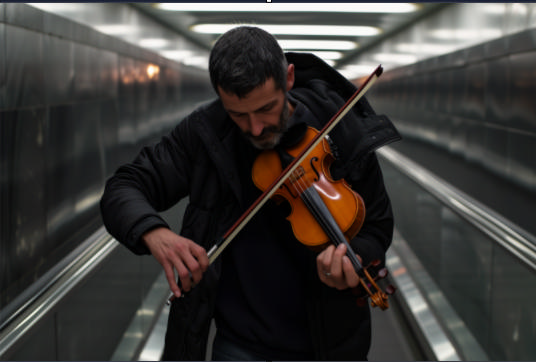
Though this story is humorous, it is also typical. Many limit Jesus to a building, a picture, a statue, a musical style, or a level of ceremonial decorum. To illustrate this point, a few years ago, a famous violinist dressed in casual clothes played incognito in a New York subway station. He performed world-class music on a million-dollar instrument. Most people hurried past, barely noticing. Yet days earlier, people paid hundreds of dollars to hear the same musician play the same music in a concert hall. Same musician, same instrument, same music—different setting and different expectations. Have we trained ourselves to worship God only when the environment feels right?
Let us return to the arena for one final question.
The question "Are you not entertained?" still echoes—but it was never meant to be the goal of worship. Entertainment asks, Did this hold my attention? Worship asks, Was God honored? Entertainment seeks applause; worship seeks surrender. One centers on the crowd's reaction, the other on God's holiness. Remember, in true worship, God is the audience, not people.
The danger is not that worship is joyful, engaging, or even beautiful, for it should be (i.e., the ornate beauty of the Temple design). The danger is when beauty replaces brokenness, when excitement substitutes for repentance, and when excellence crowds out obedience. When worship becomes something we evaluate rather than something that evaluates us, we have quietly shifted from altar to audience.
The violinist in the subway reminds us that worth does not change with setting—only perception does. God is no less worthy when the music is simple, the room is plain, or the moment feels ordinary. The question is not whether worship moves us, but whether we are willing to be moved toward God—toward humility, obedience, justice, and love.
Perhaps the better question is not "Did you enjoy the service?" but "Did we offer God what He deserves?" Did we come as consumers or as worshipers? Did we leave impressed—or transformed?
God is not competing for our attention; He is calling for our allegiance. He is not seeking a crowd to entertain but a people to conform to the image of His Son. True worthship may stir the emotions, but it will always reshape the heart and reorient life.
So the question remains—not shouted in sarcasm, but whispered in sincerity:
Are we not entertained—or are we truly worshiping?
References:
Davis, Jim, and Michael Graham. The Great Dechurching: Who's Leaving, Why Are They Going, and What Will It Take to Bring Them Back? Grand Rapids, MI: Zondervan Reflective, 2023
Tozer, A.W. The Root of the Righteous. Moody Publishers, 2015.
Welch, E. T. (2023). When people are big, and God is small: Overcoming peer pressure, codependency, and the fear of man (2nd ed.). P&R Publishing.

Eddie Riley
Eddie Riley is the ADMINISTRATOR, SENIOR BIBLE Instructor for Cross Lanes Christian School, and has served in this position since 2013. He has faithfully ministered in Christian Education for over 40 years at schools in NC, AZ, FL, VA, NJ, and WV. Eddie holds a BA in Bible from Bob Jones University, and M.Ed. from West Coast Baptist College