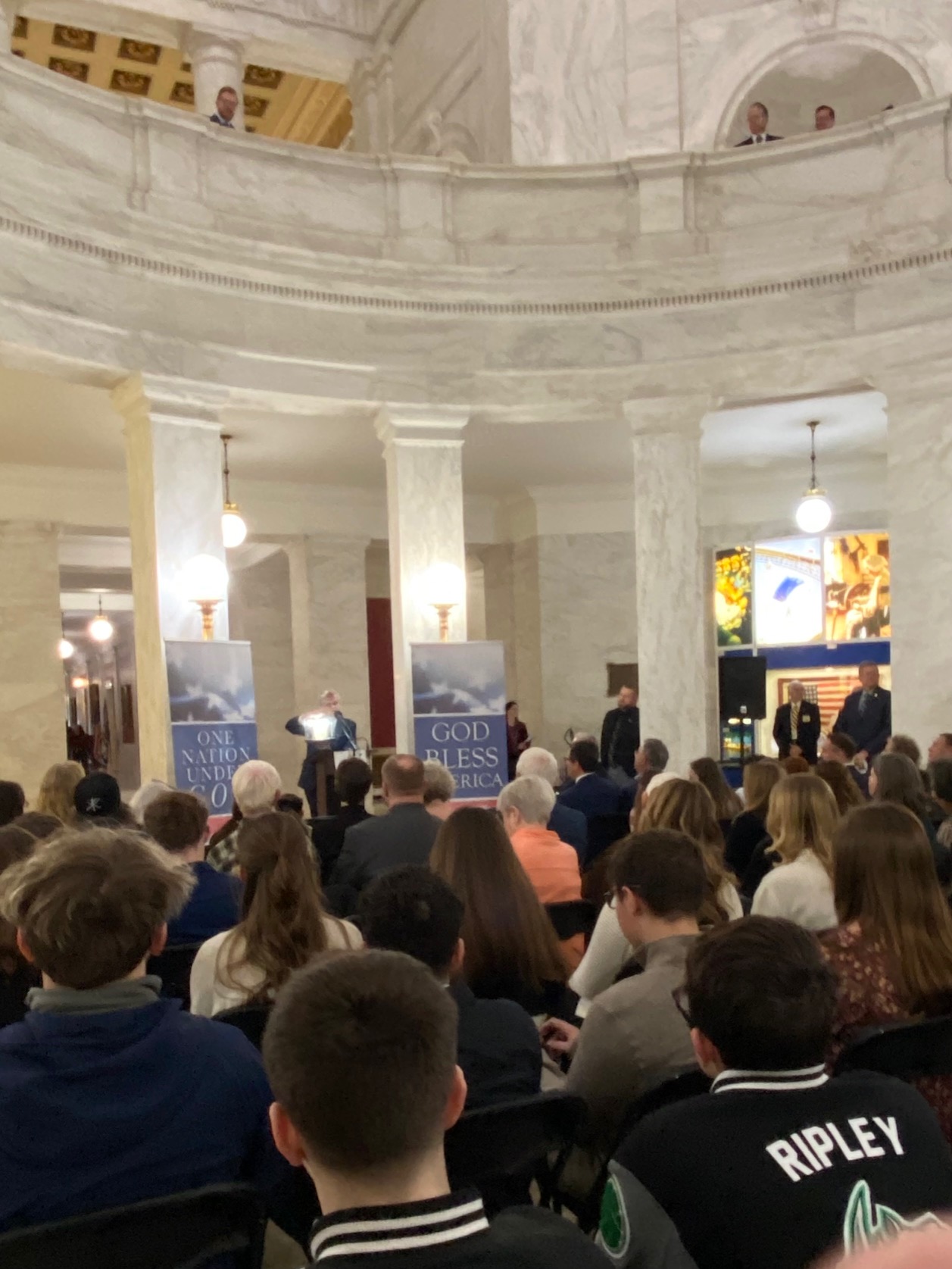
Day of the Bible at the Capitol- Standing Room ONLY
"we greatly fear that unless timely care be used to prevent it, we shall not have bibles for our schools and families"
Dear Friends and Supporters,
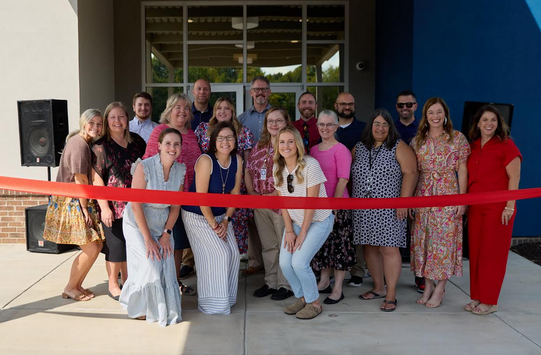
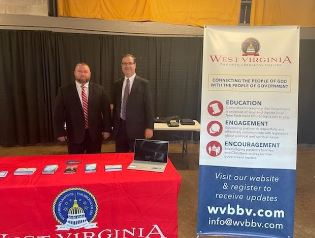
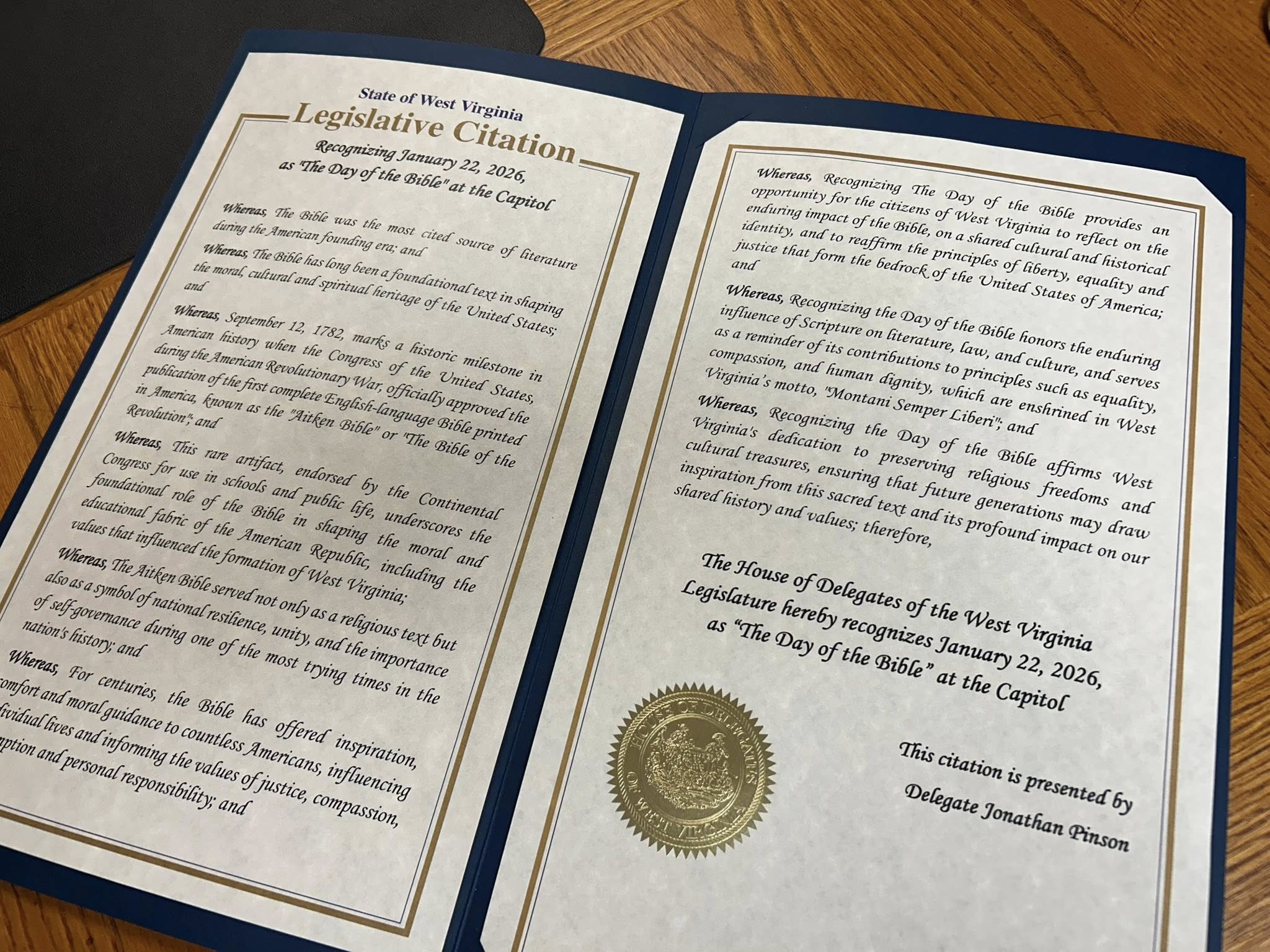
On behalf of West Virginia Baptists for Biblical Values, we would like to extend our heartfelt thanks to each of you for your prayers, participation, and support in making Day of the Bible at the West Virginia State Capitol a tremendous success. Governor Morrisey, the West Virginia Senate and the West Virginia House all issued Proclamations that helped fill the Capitol with standing room only.
Because of your faithfulness and encouragement, God was honored in a very visible way at our Capitol. It was a blessing to see believers gather openly, the Word of God lifted up, and Scripture recognized for its lasting influence on our nation, our state, and our lives. Your support helped ensure that this event was conducted with excellence, reverence, and boldness.
We would like to offer a special word of gratitude to Stephen Skelton and the First American Bible Project for their extraordinary contribution in bringing the First American Bible for public display. This historic Bible served as a powerful reminder of the foundational role God’s Word has played in shaping American faith, liberty, and law. Many who attended were deeply moved by the opportunity to see and reflect upon this important piece of our spiritual heritage. We praise the Lord for those who received Jesus Christ and salvation.
As Scripture reminds us, “The grass withereth, the flower fadeth: but the word of our God shall stand for ever.” (Isaiah 40:8, KJV). We are grateful to stand alongside supporters like you who believe in the enduring truth and authority of God’s Word.
Thank you again for standing with us, praying for us, and helping advance biblical values in the public square. May the Lord richly bless you for your faithfulness, and may His Word continue to guide our churches, our communities, and our state.
What can you do NOW?
Senate Bill 388 is the Robert Aitken Bible in schools bill. This bill requires that a 1782 Robert Aitken Bible be placed in every 4th, 8th, and 10th grade classroom in West Virginia.
It is to be used as a historical artifact in teaching American History during the revolution. This Bible is historically significant because it is the first English bible printed in the United States. It was also the only Bible ever recommended and approved by congress for the American people. This bill will be paid for by private donations and not use tax payer dollars. The First American Bible will be made available to teachers and students. They will not be forced to used it.
This bill is on third reading today, Thursday, January 29, and will be voted on. Please call and/or email your senators and kindly encourage them to vote yes on SB 388.
Click on the RED BOX BELOW to email your legislators
With sincere appreciation and Christian love,
Pastor Bo Burgess
Director, WV Baptists for Biblical Values
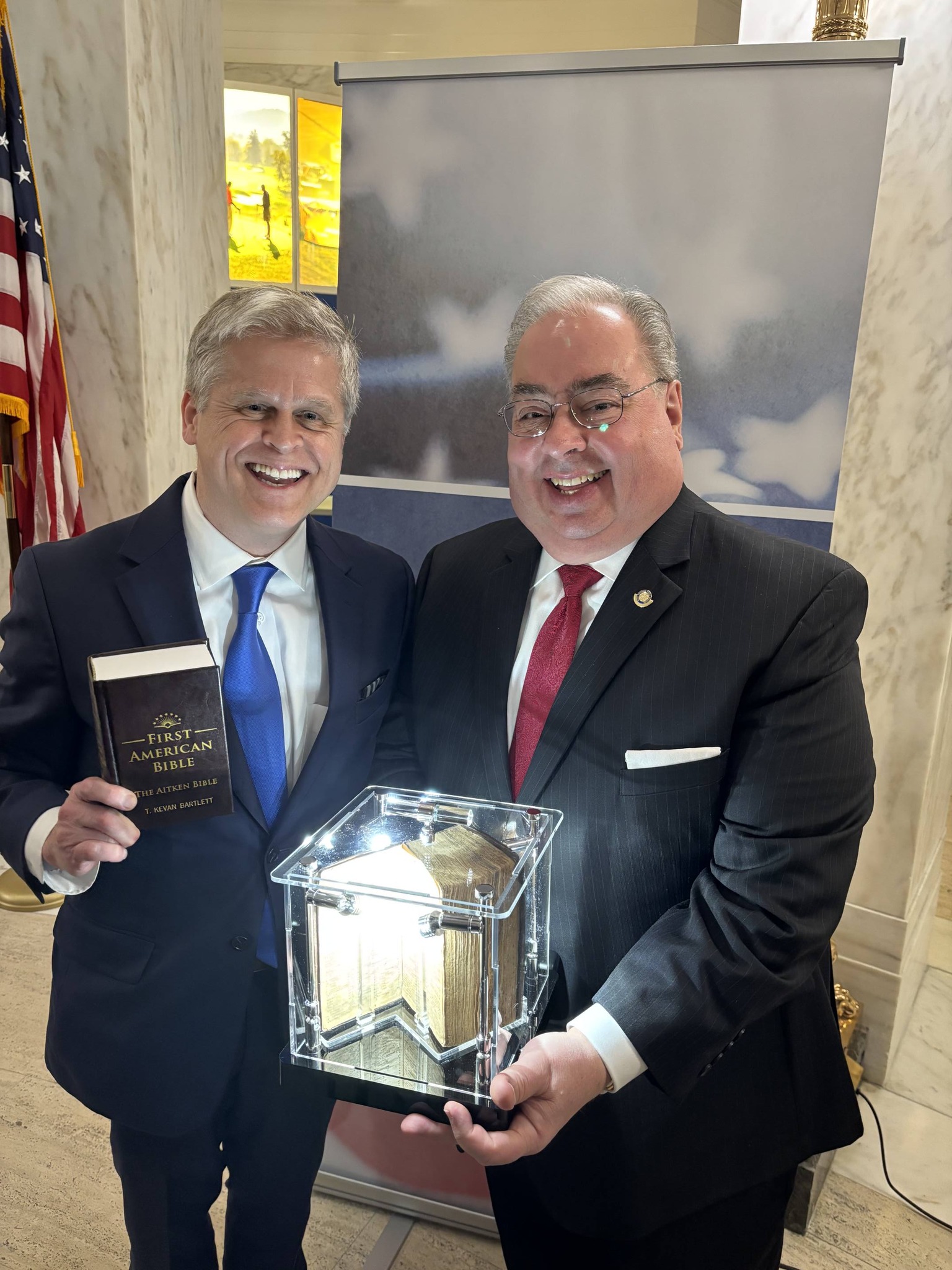
A little bit of history about The Only Bible Approved by Congress
By 1777, the War of the American Revolution had entered its second year. Since the fateful firing of the "first shot" on Lexington Green, the Continental Congress, sitting in Philadelphia, had been required to make many crucial decisions, both military and political.
Now, in July 1777, a petition signed by three clergymen was placed before that dedicated body of colonial representatives, calling for a determination of an entirely different nature.
The embargo on trade with Britain had cut off our supply of Bibles. In addition, the British royal license on the Bible made it illegal to print the King James version in America. For these reasons, America was running out of Bibles. Thus, three pastors wrote to our Founders in Congress.
To the honourable Continental Congress of the United States of North America now sitting in Philadelphia.
Honoured Gentlemen
We the Ministers of the Gospel of Christ in the City of Philadelphia, whose names are under written, taking it into our serious consideration that in our present circumstances, books in general, and in particular, the holy Scriptures contained in the old and new Testaments are growing so scarce and dear, that we greatly fear that unless timely care be used to prevent it, we shall not have bibles for our schools and families, and for the publick worship of God in our churches.
We therefore think it our duty to our country and to the churches of Christ to lay this danger before this honourable house, humbly requesting that under your care, and by your encouragement, a copy of the holy Bible may be printed, so as to be sold nearly as cheap as the common Bibles, formerly imported from Britain and Ireland, were sold.
The number of purchasers is so great, that we doubt not but a large impression would soon be sold, But unless the sale of the whole edition belong to the printer, and he be bound under sufficient penalties, that no copy be sold by him, nor by any retailer under him, at a higher price than that allowed by this honourable house, we fear that the whole impression would soon be bought up, and sold again at an exorbitant price, which would frustrate your pious endeavours and fill the country with just complaints.
We are persuaded that your care and seasonable interposition will remove the anxious fears of many pious and well disposed persons; would prevent the murmurs of the discontented; would save much money to the United States; would be the means of promoting Christian knowledge in our churches, and would transmit your names with additional honour to the latest posterity.
Our sincere prayers shall ever be for your welfare and prosperity, and we beg leave with the greatest respect to subscribe our selves
Honoured Gentlemen
Your most obedient humble servants, Francis Alison, John Ewing, William Marshalle
Congress Considers the Bible
The petition was referred to a committee of three, which included John Adams, the future second president of the United States. Adams and the others (Daniel Roberdeau and Jonathan Bayard Smith) drafted a questionnaire on Bible printing for the printers in Philadelphia. Among these printers was Robert Aitken, who had served as the appointed printer for the Journals of Congress since September 1776. (Aitken would continue as the appointed printer until May 1778.) Notably, Aitken published the first volume of the Journals containing the Declaration of Independence.
Back in Congress, the petition was reported on again on September 11, 1777. In the report, John Adams and the others stated that the committee had "conferred fully with the printers, etc. in this city and are of the opinion, that the proper types for printing the Bible are not to be had in this country, and that the paper cannot be procured, but with such difficulties and subject to such casualties as render any dependence on it altogether improper…."
Therefore, the report continued, since “the use of the Bible is so universal, and its importance so great … your committee recommend that Congress will order the Committee of Commerce to import 20,000 Bibles from Holland, Scotland, or elsewhere, into the different ports of the states in the Union."
Yet, on that day, Congress was also focused on more pressing matters. That same day American General George Washington was fighting the Battle of the Brandywine. At the same time, British General John Burgoyne was on his way toward Saratoga. Before long, Philadelphia would he occupied by the British troops of General Sir William Howe, and Congress itself would flee to Lancaster and then to York.
While the motion carried by a narrow margin, seven to six, a subsequent motion was passed ordering "that the consideration thereof be postponed to Saturday next." However, since nothing more is known concerning this resolution, it is doubted whether the beleaguered Congress ever took steps to effect its implementation.
Adams, Aitken, and the Bible
Meanwhile, several weeks after John Adams and the others had sent the questionnaire on Bible printing to Robert Aitken, Aitken published the first New Testament in America. Aitken placed an advertisement for his New Testament in the Pennsylvania Evening Post on August 28, 1777.
It is interesting to consider that either John Adams gave Robert Aitken the idea to print the first New Testament in America or the timing was quite a coincidence. Finding the demand high for his New Testament, for the next five years, Aitken published a new edition each year.
Thus, the seeds had been planted for the first American Bible. Indeed, the work done so far would prove to be a warm-up to the main event: not only the printing of a New Testament which was possibly influenced by John Adams, but a complete edition of the Holy Scriptures which would become the only Bible approved by Congress.
The Only Bible Recommended to Americans
On January 21, 1781, it seemed at last to have been an opportune time for Robert Aitken to present to Congress a memorial on the first English Bible to be made in America.
To the Honourable The Congress of the United States of America
The Memorial of Robert Aitken of the City of Philadelphia, Printer
Humbly Sheweth
That in every well regulated Government in Christendom The Sacred Books of the Old and New Testament, commonly called the Holy Bible, are printed and published under the Authority of the Sovereign Powers, in order to prevent the fatal confusion that would arise, and the alarming Injuries the Christian Faith might suffer from the Spurious and erroneous Editions of Divine Revelation. That your Memorialist has no doubt but this work is an Object worthy the attention of the Congress of the United States of America, who will not neglect spiritual security, while they are virtuously contending for temporal blessings. Under this persuasion your Memorialist begs leave to inform your Honours That he both begun and made considerable progress in a neat Edition of the Holy Scriptures for the use of schools, But being cautious of suffering his copy of the Bible to Issue forth without the sanction of Congress, Humbly prays that your Honours would take this important matter into serious consideration & would be pleased to appoint one Member or Members of your Honourable Body to inspect his work so that the same may be published under the Authority of Congress. And further, your Memorialist prays, that he may be commissioned or otherwise appointed & Authorized to print and vend Editions of the Sacred Scriptures, in such manner and form as may best suit the wants and demands of the good people of these States, provided the same be in all things perfectly consonant to the Scriptures as heretofore Established and received amongst us.
And as in Duty bound your Memorialist shall every pray
Robt. Aitken Philadelphia. 21, Jany. 1781.
An Appointed Printer
Of course, by this point, Robert Aitken was no stranger to the respected gentlemen of Congress. Years earlier, from September 1776 until May 1778, he had served as the appointed printer for the Journals of Congress.
In December 1776, when the Continental Congress retreated to Baltimore, they sent an "express" to Aitken requesting that he bring his press and utensils at public expense to Baltimore, where he might locate and continue his engagement with Congress. But Aitken decided to remain in Philadelphia.
Presently, on January 26, 1781, Robert Aitken's memorial to Congress for aid in printing the Bible was referred to "the committee on the Motion for Printing the Old and New Testament," but it would be over 18 months before any action was taken on it.
On September 1, 1782, the committee appointed by Congress to consider Aitken's project learned the completed Bible was almost ready for publication. At last, the representatives took action by requesting the Chaplains of Congress to examine the proposed edition for accuracy.
The Chaplains of Congress
The two Chaplains of Congress were distinguished citizens of Philadelphia—from different denominations—a sign the American Congress, unlike their British counterparts, would not favor one religious group over another.
The first chaplain, Rev. Dr. William White, rector of Christ Church, was instrumental in organizing the Protestant Episcopal Church in America. He later became the first president of the Bible Society of Philadelphia, the first Bible Society established in the United States.
The second chaplain, the Rev. George Duffield, was pastor of the Third Presbyterian Church in Philadelphia. After the war, he was to be one of the leaders in the formation of the Presbyterian Church in the United States.
But before the report of the Chaplains was received, Aitken himself sent another memorial to Congress. Dated September 9th, it declared that his Bible, "accomplished in the midst of the Confusion and Distresses of War," had at last been completed. In seeking the aid of Congress, he suggested their purchase of a portion of the edition on the account of the United States: "One Fourth of it will Amount to 200 Bibles for each State…."
The First American Bible
The Chaplains of Congress, Dr. White and Mr. Duffield, gave a favorable report on September 10, 1782, praising Aitken's Bible for its "great accuracy". Two days later, on the 12th, the Committee reported to Congress, submitting copies of both their request to the Chaplains and the Chaplains' report.
The same day Congress declared they “highly approve the pious and laudable undertaking of Mr. Aitken, as subservient to the interest of religion, as well as an instance of the progress of arts in this country…." In addition, our Founders continued, “they recommend this edition of the Bible to the inhabitants of the United States….”
Furthermore, Congress graciously authorized Aitken “to publish this recommendation in any manner he shall think proper." Aitken thought it proper to print the official documents in his Bible, immediately following the title page.
Thus, Atiken published his Bible on September 25th, 1782. That day Aitken placed an advertisement of his Bible, just below the full text of the action of the Congress and the Committee reports, in the Freeman's Journal, a periodical established in 1781 whose masthead claimed that it was "Open to all parties but influenced by none."
On that same day, Aitken sent a parcel to John Hanson, then president of the Congress. The item included was for the use of that body and as an example of the work they had honored with their patronage. Inside the package, the president of the Congress found a special copy of the Aitken Bible—the only Bible recommended to Americans by our Founders.
The First English Bible Made in America
The first English Bible made in America was relatively small in dimensions. It measured but five and five-eighths inches by three and one-eighth inches. Printed in brevier type on American-made paper, it contained 726 leaves (1,452 pages). It is considered to be an excellent piece of printing with remarkably few divided words and with pages unmarred by "rivers" of blank space.
The edition consisted of 10,000 copies in which, as was the custom in small King James version Bibles, the books of the Apocrypha were omitted. The graceful title page carried the coat of arms of Pennsylvania. Below that was the designation "Printed and Sold by R. Aitken."
George Washington
When the Aitken Bible was issued, the American Revolution was nearing its end. In 1783, Dr. John Rodgers, pastor of the First Presbyterian Church in New York, wrote to his friend General George Washington concerning the Aitken Bible. Rodgers suggested that copies of the Aitken Bible could be presented to each of the soldiers in the army when they were discharged.
General Washington replied that, unfortunately, this worthy suggestion came too late. Congress had already ordered the discharge of two-thirds of the army. The Father of Our Country lamented the fact that he would not be able to give a copy of the Aitken Bible to each of his men, writing:
Your Proposition respecting Mr Aikins Bible would have been particularly noticed by me, had it been suggested in season. But the late Resolution of Congress for discharging Part of the Army, takg off near two thirds of our Numbers, it is now too late to make the Attempt. It would have pleased me well, if Congress had been pleased to make such an important present to the brave fellows; who have done so much for the Security of their Country’s Rights and Establishment.
Sacrifice and Perseverance
With the cessation of hostilities, trade was soon renewed with Britain and the Continent. For Robert Aitken, it meant that the sale of his Bible would be challenged by the importation of less expensive and more attractive copies of the Scriptures.
Many years later, in 1808, daughter Jane Aitken was to publish a four-volume Bible which contained the translation of the Greek Septuagint Old Testament. This work was written by Charles Thomson, who had served as secretary through the entirety of the Continental Congress, from 1774 until his retirement in 1789. His Bible was the first translation of that Greek text into English ever made.
Today, of the original 10,000 copies of his Bible, only a few are known to exist. In 1940, the Rev. Edwin A. R. Rumball-Petre was able to locate 28 copies in institutions here and abroad and 22 in private collections. A more recent estimate places the number at only 32 copies in total, with three of these in private hands. Imagination alone may dare to suggest the fate of the rest.
In fact, the Aitken Bible has become one of the rarest books in the world. In addition, it has become one of the most highly sought after. An auction of one original Aitken Bible at Christie’s on June 14, 2018 yielded a winning payout of $118,750
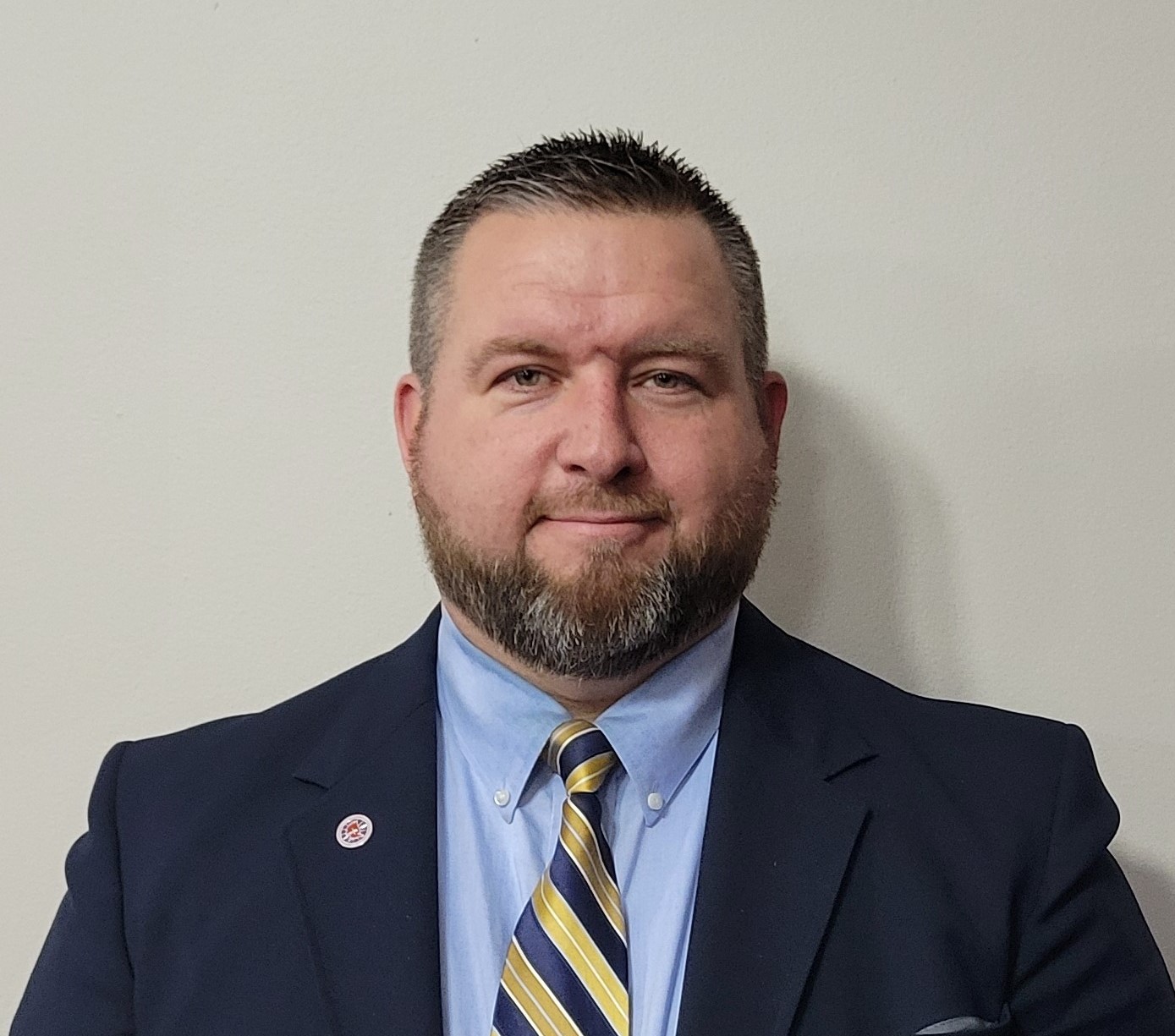
Bo Burgess
Pastor Jordan Baptist Church Gallipolis Ferry, Mason County Director, WV Baptists for Biblical Values President of Mason County Right to Life Chapter