Separation of Church and State: What It Really Means From the Founding Fathers to the Hope Scholarship?
Why is the Hope Scholarship Constitutionally Legal?
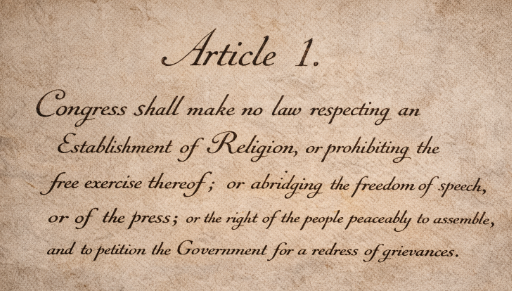
The real meaning of “separation of church and state” is not the removal of religion from public life but the protection of religious freedom through two complementary Constitutional principles:
The government cannot establish any preferred religion, and it cannot control or discriminate against religious people or institutions. From the Baptists and Anabaptists to modern Supreme Court rulings to the Hope Scholarship, the consistent thread is this—religion must remain free, and citizens must be treated equally. Under that framework, West Virginia’s Hope Scholarship does not violate the Constitution; it exemplifies it.
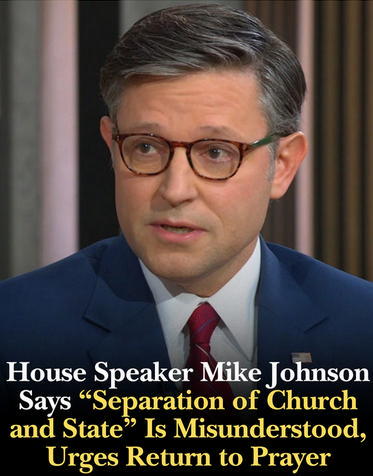
As the United States approaches the 250th anniversary of the Declaration of Independence, debates over religion and government are once again at the center of national conversation. At the 2026 National Catholic Prayer Breakfast, House Speaker Mike Johnson argued that “separation of church and state” is one of the most misunderstood ideas in American life. His remarks have reignited a long-standing question: What did the founders actually mean—and how is that meaning demonstrated in our every-day lives?
To answer that question, it is necessary to trace the idea from its origins through Supreme Court interpretation to its present-day application. The answer lies in a combination of history and law stretching from persecuted religious minorities in Europe to modern Supreme Court rulings on school funding.
At its core, the phrase “separation of church and state” does not appear in the Constitution. Instead, it comes from an 1802 letter written by Thomas Jefferson to the Danbury Baptist Association. In that letter, Jefferson wrote that the First Amendment built “a wall of separation between church and state.” However, the Constitution itself uses different language: “Congress shall make no law respecting an establishment of religion, or prohibiting the free exercise thereof.”
These two clauses—no establishment and free exercise—form the legal bedrock. Jefferson’s phrase was an explanation, not a law. Understanding what he meant requires stepping back into the world that shaped the founders.
In Europe, governments commonly controlled religion. In England, the Church of England functioned as the official state church, and citizens were expected to conform. Dissenters, including Baptists, faced fines, imprisonment, and social exclusion. Religion was not a private matter; it was enforced by the state.
Even more radically opposed to state control were the Anabaptists. Emerging during the Protestant Reformation, they rejected infant baptism and insisted that faith must be voluntary. Because they refused to submit to state churches, they were persecuted by both Protestant and Catholic authorities. Many were executed. Their core belief—that the church must remain independent from government—would later influence American thinking.
Baptists carried these ideas into both England and the American colonies. They believed that faith must be freely chosen and that government should never compel religious practice. Yet in colonial America, several regions still had established churches. In Virginia, for example, the Anglican Church was supported by taxes. Baptists and other dissenters were required to pay for a church they did not attend. Some Baptist preachers were jailed simply for preaching without government approval.
This tension led to a turning point. Leaders like Thomas Jefferson and James Madison pushed for religious liberty. Jefferson’s Virginia Statute for Religious Freedom, passed in 1786, declared that no person should be compelled to support any religious worship. This principle directly shaped the First Amendment.
When the Danbury Baptists wrote to Jefferson, they feared that the new federal government might one day act like European governments—controlling or favoring religion. Jefferson reassured them that the First Amendment prevented that. His “wall of separation” was intended to protect the church from government interference.
This is the historical interpretation emphasized by Mike Johnson. According to this view, the founders did not intend to remove religion from public life. Instead, they wanted to prevent the government from controlling religion while allowing faith to flourish freely in society.
From the founding of the United States, religion was deeply present in public life. Congress employed chaplains. Presidents issued calls to prayer. Public officials frequently referenced God. These actions were not seen as violations of the Constitution because they did not establish a national church or coerce belief.
However, the interpretation of the First Amendment began to shift in the 20th century. A major turning point came with the Supreme Court’s 1947 decision in Everson v. Board of Education. In Everson, a New Jersey town reimbursed parents for transportation costs to both public and Catholic schools. A taxpayer challenged the program, arguing that it violated the Establishment Clause. The Supreme Court upheld the program. Although it used Jefferson’s “wall of separation” language, it ruled that the reimbursement was constitutional because it was a general public benefit provided equally to all students.
This decision introduced a crucial legal principle: neutrality. If the government provides a general benefit, it cannot exclude people simply because they are religious. In practical terms, if transportation is provided for public school students, it must also be available to students attending religious schools. To deny them access would be discrimination.
This principle marked an important shift. The founders focused on preventing government control of religion. The Court added a second protection: preventing government discrimination against religion. That principle has continued to develop in modern Supreme Court decisions.
In Zelman v. Simmons-Harris (2002), the Court upheld a school voucher program even though many families used vouchers at religious schools. The Court ruled that the program was constitutional because the aid reached religious schools only through the independent choices of parents.
In Espinoza v. Montana Department of Revenue (2020), the Court ruled that if a state creates a program to support private education, it cannot exclude religious schools simply because they are religious.
In Carson v. Makin (2022), the Court went further, ruling that states cannot exclude schools because they provide religious instruction.
Together, these cases establish a clear rule: government must remain neutral toward religion, and neutrality means inclusion—not exclusion. This brings us directly to modern policy—and specifically to West Virginia’s Hope Scholarship.
The Hope Scholarship is structured as an education savings account program. Instead of funding schools directly, the state provides eligible families with funds that they can use for a variety of educational purposes, including tuition, tutoring, curriculum, and other approved services. The critical constitutional feature is this: the state does not decide where the money goes. Parents do.This places the program squarely within the framework approved by the Supreme Court.
First, the program is neutral. It is available based on student eligibility, not religious affiliation.
Second, the program is based on private choice. Families—not the government—decide whether to use funds for public, private, secular, or religious education.
Third, the benefit is general. It is not targeted at religion but applies broadly across educational options.
Under the reasoning of Zelman, this kind of parent-directed funding does not constitute an establishment of religion because the government is not directing funds to religious institutions.
Under Espinoza, excluding religious schools from such a program would likely be unconstitutional discrimination.
Under Carson, even excluding schools because they provide religious instruction would violate the Free Exercise Clause.
In other words, the Hope Scholarship does not violate the Constitution—it reflects modern constitutional law.
It also aligns with the deeper historical principle that the founders were pursuing. The Baptists and Anabaptists did not fight for a system that excluded religion from public life. They fought for a system where government could not control or suppress religious belief. Modern Supreme Court doctrine extends that protection by ensuring that government also cannot exclude religious citizens from public benefits.
This creates a dual protection: Government cannot establish religion. Government cannot discriminate against religion. The Hope Scholarship operates within that balance which was created by the Founding Fathers.
It is also important to understand what the program does not do.
It does not create a state church.
It does not require religious participation.
It does not fund religious instruction directly through government action.
Instead, Hope empowers families to make their own decisions.
That distinction—between government action and private choice—is the bridge in constitutional law.
The Hope Scholarship fits within the category the Court has consistently upheld. Seen in this broader context, the program is not a departure from “separation of church and state.” It is an example of how that principle has developed. The founders sought to prevent government control of religion.The courts have added that government must not exclude religion.Together, these principles form the modern understanding of religious liberty.
On February 8, 2021, the then West Virginia Attorney General Patrick Morrisey made a promise to 41 people sitting in a conference room int he West Virginia Capitol “If you let me write the Hope Bill, I will make it legal and defensible”. He kept his promise.
Founding Era / Historical Background
- Jefferson, Thomas.
“Letter to the Danbury Baptist Association” (January 1, 1802).
Source: Library of Congress
https://www.loc.gov/loc/lcib/9806/danpre.html - U.S. Constitution, First Amendment.
Source: National Archives
https://www.archives.gov/founding-docs/bill-of-rights-transcript - Jefferson, Thomas.
Virginia Statute for Religious Freedom (1786).
Source: National Archives
https://www.archives.gov/milestone-documents/virginia-statute-for-religious-freedom - Madison, James.
“Memorial and Remonstrance Against Religious Assessments” (1785).
Source: National Archives
https://founders.archives.gov/documents/Madison/01-08-02-0163
Church of England / Established Religion
- Encyclopaedia Britannica.
“Church of England.”
https://www.britannica.com/topic/Church-of-England - Berman, Harold J.
Law and Revolution II: The Impact of the Protestant Reformations on the Western Legal Tradition. Harvard University Press, 2003.
Baptists and Religious Persecution in Colonial America
- Isaac Backus.
A History of New England with Particular Reference to the Denomination of Christians Called Baptists (1777–1796). - McLoughlin, William G.
New England Dissent, 1630–1833. Harvard University Press, 1971. - Library of Congress.
“Religion and the Founding of the American Republic.”
https://www.loc.gov/exhibits/religion/rel01.html
Anabaptist Persecution (Catholic and Protestant)
- Encyclopaedia Britannica.
“Anabaptist.”
https://www.britannica.com/topic/Anabaptists - González, Justo L.
The Story of Christianity, Vol. 2. HarperOne, 1985. - Bender, Harold S.
“The Anabaptist Vision.” Church History, 1944. - van Braght, Thieleman J.
Martyrs Mirror (1660). - Hillerbrand, Hans J. (ed.)
The Oxford Encyclopedia of the Reformation. Oxford University Press, 1996.
Founders’ View of Religion in Public Life
- Washington, George.
Farewell Address (1796).
https://avalon.law.yale.edu/18th_century/washing.asp - Adams, John.
Letter to Massachusetts Militia (1798).
https://founders.archives.gov/documents/Adams/99-02-02-3102
Supreme Court – Foundational Case
- Everson v. Board of Education, 330 U.S. 1 (1947).
https://supreme.justia.com/cases/federal/us/330/1/ - Constitution Annotated (Congressional Research Service).
Establishment Clause Interpretation
https://constitution.congress.gov
Modern School Funding / Religious Liberty Cases
- Zelman v. Simmons-Harris, 536 U.S. 639 (2002).
https://supreme.justia.com/cases/federal/us/536/639/ - Espinoza v. Montana Department of Revenue, 591 U.S. ___ (2020).
https://www.supremecourt.gov/opinions/19pdf/18-1195_g314.pdf - Carson v. Makin, 596 U.S. ___ (2022).
https://www.supremecourt.gov/opinions/21pdf/20-1088_dbfi.pdf
Modern Constitutional Interpretation (Neutrality Doctrine)
- Congressional Research Service.
“Establishment Clause: Overview of Supreme Court Doctrine.”
https://constitution.congress.gov/browse/essay/amdt1-3-4-5/ALDE_00013078/
West Virginia Hope Scholarship
- West Virginia Hope Scholarship Program (Official Site).
https://hopescholarshipwv.gov - West Virginia Legislature.
Hope Scholarship Act (HB 2013 and subsequent updates).
https://www.wvlegislature.gov
Supporting Historical/Legal Analysis
- Hamburger, Philip.
Separation of Church and State. Harvard University Press, 2002. - McConnell, Michael W.
“Religious Freedom at a Crossroads.” University of Chicago Law Review

HGN Staff
His Good News magazine seeks to unite and empower parents, educators, legislators, and voters in West Virginia to support and advance Christian education, religious freedom, and conservative values. By fostering a strong Jesus-based foundation within our communities, we can influence legislation, protect religious freedoms, and ensure that our children receive a quality Christian education.