When Life Looks Tangled
Life sometimes is like a tapestry. The backside of our lives often is characterized by random, dark, tangled, or painful lessons. We see the backside, but God sees the front.

Have you ever witnessed something that raised your confusion to a new level? I memorized a silly song years ago about a fellow who looked at a billboard after a storm had revealed the various layers of previous advertisements.
The song went like this:
As I was walking down the street one dark and dreary day.
I looked up at a billboard and there, to my dismay,
The sign was torn and tattered by the storm the day before,
Wind and rain had claimed its shame, and this is what it bore:
Drink Coca Cola cigarettes, chew Wriggly Spearmint beer
Ken L Ration dog food makes your complexion clear.
Simonize your baby with a Hershey's chocolate bar
And Texaco’s the cream that’s best, it’s used by every star
So, take your next vacation in a brand-new Frigidaire
Learn to play piano in your winter underwear
Doctors say that children should smoke till they are three
And people over 65 take baths in Lipton tea
You can make this country a better place today
Just buy a copy of this song and throw it far away.
That silly song often reflects how we see the partial pieces of our lives that don’t make sense in the present. Sometimes the storms of life fray and distort a plan or purpose. Philippians 1:6 assures us to be “confident of this very thing, that He who hath begun a good work in you will perform it until the Day of Jesus Christ.” Romans 8:28 reinforces the believer's confidence that “... all things work together for good to them that love God and are the called according to His purpose.”
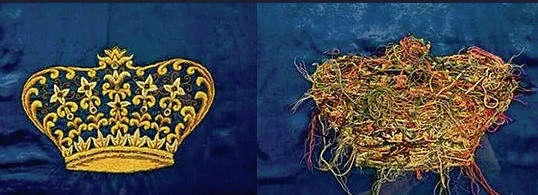
Have you ever seen a tapestry?
A tapestry is a piece of textile art, usually woven by hand, in which threads of different colors are interlaced to create a picture, pattern, or design. Unlike printed fabrics, a tapestry’s image is woven directly into the material, so the colors and threads themselves form the picture. The artist uses a loom, a device or a machine that weaves threads into fabric to create a picture of a design.
Growing up, my parents had a tapestry-like picture of the Last Supper hanging in the living room. While throwing a football in the house, which was strictly forbidden, we knocked the framed tapestry picture off the wall and broke the frame. That’s when I discovered the hidden secret of the backside of the tapestry. The back looked tangled, knotted, and even chaotic. The backside did not resemble anything like the front, which was beautiful, intentional, and purposeful.
Life sometimes is like a tapestry. The backside of our lives is often characterized by random, dark, tangled, or painful lessons. We see the backside, but God sees the front. We see knots; God sees design. Delays, disappointments, and detours are all threads, not the whole tapestry. The admonition to “walk by faith and not by sight” (2 Cor. 5:7) is insightfully applicable in this metaphor.
God uses the threads, even the inconvenient and broken ones. Past sins, painful memories, and a plethora of poor decisions can be used by God to weave a masterpiece of our lives. He uses different threads through different people and different circumstances. A tapestry is strong and unique because it is diverse rather than uniform. There is one glaring truth: God is definitely the weaver, not circumstances, or people, or Satan. The tapestry of our lives reveals the sovereignty of God, encouraging the believer not to fear the unknown or yield to doubt about God's craftsmanship.
Consider Psalm 73.
Asaph was perplexed by the seemingly inconsistent and tangled lessons of life. He shares with us a brutally honest observation along with his conclusive analysis.
He begins with a confession of truth—but not a confident understanding.
He knows God is good, but his heart is wobbling. “Truly God is good to Israel, to those who are pure in heart. But as for me, my feet had almost slipped…” (v1-.2)
Let us first understand that this psalm is for believers who love God, know the truth, and still struggle when life seems unfair. Asaph’s honesty allows us to admit something many Christians feel but rarely say out loud: “I was envious of the arrogant when I saw the prosperity of the wicked” (v. 3). Even strong faith can stumble, especially when we compare our lives to others. The Bible states that comparison with others is not wise (2 Cor. 10:12) because it disregards the sovereignty of God, Who makes us different from each other (1 Cor. 4: 7-8). Comparison is the thief of joy!
Asaph carefully describes what troubles him. Here is what he sees:
- They are healthy (v.4). “They have no pangs until death; their bodies are fat and sleek.”
- They are carefree (v.5). “They are not in trouble as others are; they are not stricken like the rest of mankind.”
- They are proud and violent (v.6). “Therefore pride is their necklace; violence covers them as a garment.”.
- They mock God and still succeed (vv. 8–11). “They scoff and speak with malice; loftily, they threaten oppression. They set their mouths against the heavens, and their tongue struts through the earth. Therefore, his people turn back to them and find no fault in them. And they say, “How can God know? Is there knowledge in the Most High?”
In other words, they cheat, don’t get caught, and get ahead. They ignore God and seem to flourish. They arrogantly mock righteousness and seem untouchable. What Asaph is expressing is not casual envy—it is theological confusion.
This leads to an internal struggle and errant reasoning. “All in vain have I kept my heart clean…” (v.13) Asaph is asking the question many faithful people ask quietly: What’s the point of obedience if wickedness wins?
Amid this evaluation and discontentment, Asaph does something wise: he does not vent recklessly but wrestles internally before God. “If I had said, ‘I will speak thus,’ I would have betrayed the generation of your children” (v.15). He does have the maturity to realize that having a discontented spirit would spread, perhaps irreparable damage to others who possibly do not possess the wisdom to seek the truth and follow a path of understanding.
Yet the struggle is exhausting.
For all the day long, I have been stricken and rebuked every morning. But when I thought how to understand this, it seemed to me a wearisome task” (v.16). Trying to make sense of life, without God’s perspective, will always lead to spiritual and physical fatigue. It will hardly ever make sense; the tapestry looks chaotic and confusing until God reveals the completed picture.
The hinge of the entire psalm is found in verse 17. “Until I went into the sanctuary of God; then I discerned their end” (v. 17). The sanctuary represented God’s presence, truth, and eternal viewpoint.
It’s worth noting that nothing in Asaph's world changed. The world remained wicked and arrogant. There is a profound truism in life: Where you stand determines what you see. What we perceive is not objective; it's our personal, filtered version, influenced by our subjective points of view. Being insecure versus confident can drastically alter how a situation is perceived. It’s Asaph that changes; he changes location, which in turn changes his perspective.

When life looks tangled, clarity does not come from more comparison—it comes from worship.
What once looked like reality is revealed as illusion. Now the picture begins to become clear. What looked like a contradiction is now shown to be part of God’s master plan. He can now see clearly. “Truly you set them in slippery places…” (v.18). Their prosperity is temporary, unstable, and ultimately empty.“They are destroyed in a moment, swept away utterly by terrors!” (v.19) Like a dream when one awakes, O Lord, when you rouse yourself, you despise them as phantoms" (v. 20). Asaph realizes, like waking up from a dream, which was more like a nightmare, that God has not lost control, judgment is real, and eternity changes everything.
Finally, once Asaph’s perspective was corrected, he turns toward inward confession and humble repentance. “When my soul was embittered… I was brutish and ignorant” (vv.21–22). He now makes one of the most beautiful declarations in all of Scripture: “Nevertheless, I am continually with you; you hold my right hand” (v.23). Even when Asaph doubted, God was holding him and never let go.
He shifts from looking inward to looking toward the eternal: “Whom have I in heaven but you? And there is nothing on earth that I desire besides you” (v.25). Temporal prosperity has lost its luster. Jesus drew the same conclusion for his disciples in Mark 8:26, “For what does it profit a man to gain the whole world and forfeit his soul.” Having a vibrant relationship with God is sufficient. Jesus told Paul in 2 Corinthians 12:9, "My grace is sufficient for you, my power is made perfect in weakness." His power and grace are more than enough to sustain us.
The tapestry has been turned around, and Asaph sees what God has created.
The Psalm closes with contrast and confidence: those far from God perish (v. 27), and those near God are confident (v. 28). “But for me it is good to be near God; I have made the Lord GOD my refuge, that I may tell of all your works” (v 28).
This is the thesis statement of the Psalm. It is not wealth, nor ease, nor fairness in this life that produces peace and contentment. It is seeing and trusting what God is creating. Psalm 73 teaches us that faith can falter at times. Envy distorts reality. But worship restores vision, and eternity settles the score. When life seems tangled, don’t abandon faith—enter God’s presence.
Creating this masterpiece takes time.
The tapestry is not woven in a day. God works through seasons, not moments. In our lives, we have different seasons. Consider the metaphor of a farmer planting his crops. There are seasons of sowing, waiting, pruning, and harvesting.
Harvesting the finished tapestry will be revealed in eternity. Paul says in 1 Corinthians 13:12, “For now we see through a glass darkly; but then face to face, now I know in part; but then shall I know even as also I am known.” And when we stand before Him one day, He will turn the tapestry around for us to see—no longer from the underside of our limited understanding, but from the fullness of His perfect plan.
God is the Master Weaver, and our lives are His tapestry. We see only the threads—the bright ones of joy, the dark ones of hardship, the tangled ones of confusion, and the frayed ones of failures. But God sees the whole design. He is weaving something eternal, something beautiful, something that reflects His glory and grace.
Just as a tapestry is woven strand by strand, so God works in our lives moment by moment. Nothing is wasted. No thread is useless. No color is misplaced. Even the knots and the loose ends have purpose in His hands.

Eddie Riley
Eddie Riley is the ADMINISTRATOR, SENIOR BIBLE Instructor for Cross Lanes Christian School, and has served in this position since 2013. He has faithfully ministered in Christian Education for over 40 years at schools in NC, AZ, FL, VA, NJ, and WV. Eddie holds a BA in Bible from Bob Jones University, and M.Ed. from West Coast Baptist College