
How K-12 Funding Works in West Virginia
Understanding the Hope Scholarship's Real Impact
Understanding the Hope Scholarship’s Real Impact
For many people, the debate over education funding sounds simple at first. They hear a large number describing how much is spent “per student,” and they assume that amount works like a check with one child’s name on it. So if that child leaves a public school, the whole check must leave too.
That idea is easy to picture. It is also the reason so many people misunderstand how school funding really works.
Education funding is not one single pot of money divided into equal pieces. It is built from several different sources, and those sources do different jobs. Some are tied more closely to student enrollment. Some are rooted in the local community. Some are connected to federal programs and legal obligations. All of that money may be discussed together when people talk about “school funding,” but it does not all move in the same way.
That matters when people talk about the Hope Scholarship.
If we want to understand what really happens when a student leaves a public school setting, we have to begin by seeing the full picture. There is no single stream of money. There are several layers, and each layer works differently.
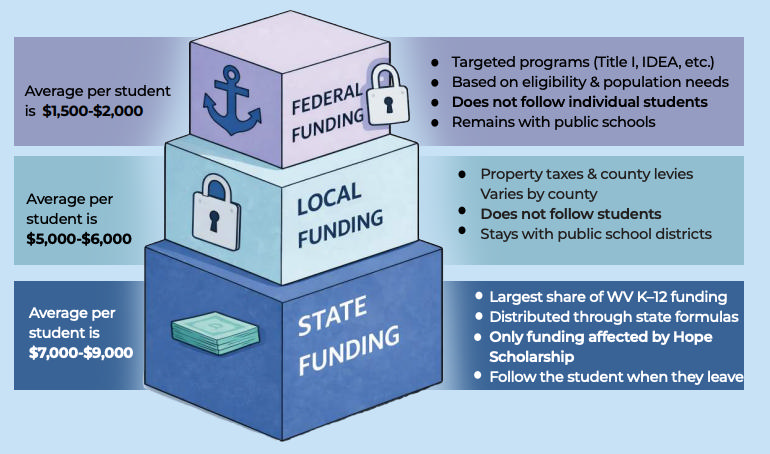
At the broadest level, K–12 education funding in West Virginia is built from three major sources: state funding, local funding, and federal funding.
The state portion is the part most closely connected to the student’s enrollment and placement. This is the layer most people are really talking about when they say money “follows the child.” It is the portion most directly tied to where that student is actually receiving an education.
Then there is local funding. This includes money raised through the local community, such as property taxes and levies. That money is part of the public-school system in that county or district. It is not designed to function like a portable grant attached to one student.
And then there is federal funding, which is often tied to specific programs, categories of students, and legal responsibilities. Those dollars are not simply packed up and moved one-for-one every time a student changes educational settings.
So the moment someone speaks as though all education funding is one simple stream that either stays or goes, the conversation has already started in the wrong place.
People often hear one large number and assume that the whole number moves with the child. But the reality is much more specific. The Hope Scholarship does not mean every public-school dollar connected in any way to that student suddenly disappears from the district. It means that the part of funding most directly connected to the student’s enrollment is treated differently from the layers that remain rooted in the public system.
That is the key to understanding the whole issue.
Why the “Per Student Average” Can Mislead
This is where many people get tripped up.
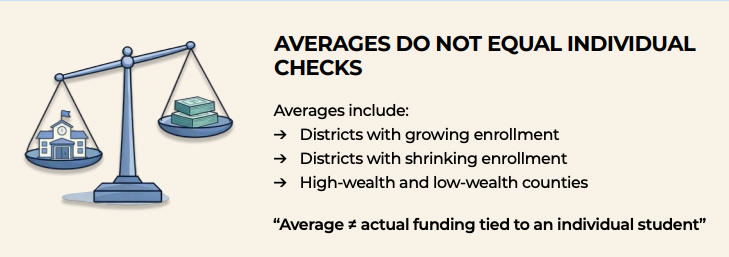
Average spending numbers sound powerful because they sound exact. A state or district spends “this much per student,” and people naturally assume that “this much” must represent a personal education allotment assigned to every child.
But averages do not work that way.
An average is a broad summary. It tells you something real, but it does not tell you what amount is directly attached to one specific student in a way that can simply be lifted out of the system whole.
Think about what is packed into an average. It may include counties with very different tax bases. It may include districts with higher transportation costs, older facilities, heavier staffing needs, or greater concentrations of student need. It may reflect schools that are growing and schools that are shrinking. It may include fixed costs and structural obligations that do not rise or fall neatly every time one student enters or leaves.
So yes, average spending numbers can help describe the overall scale of education funding. But they can also create a false impression. They can make it sound as though every child carries around an identical price tag.
That is where the confusion becomes serious.
Once people start treating an average like a literal individual check, they begin drawing the wrong conclusions. They assume that when a student leaves a public school, the school loses every dollar represented by that average figure. They begin speaking as though the entire funding structure tied to that student has been removed. From there, the conversation can quickly become emotional, exaggerated, and misleading.
The truth is more careful than that.
Average spending may describe the system in general, but it does not tell the whole story of what actually moves when one student makes a different educational choice. Until that point is understood, people will keep arguing about numbers they have not really interpreted correctly.
What Actually Changes When a Student Leaves
So what really happens?
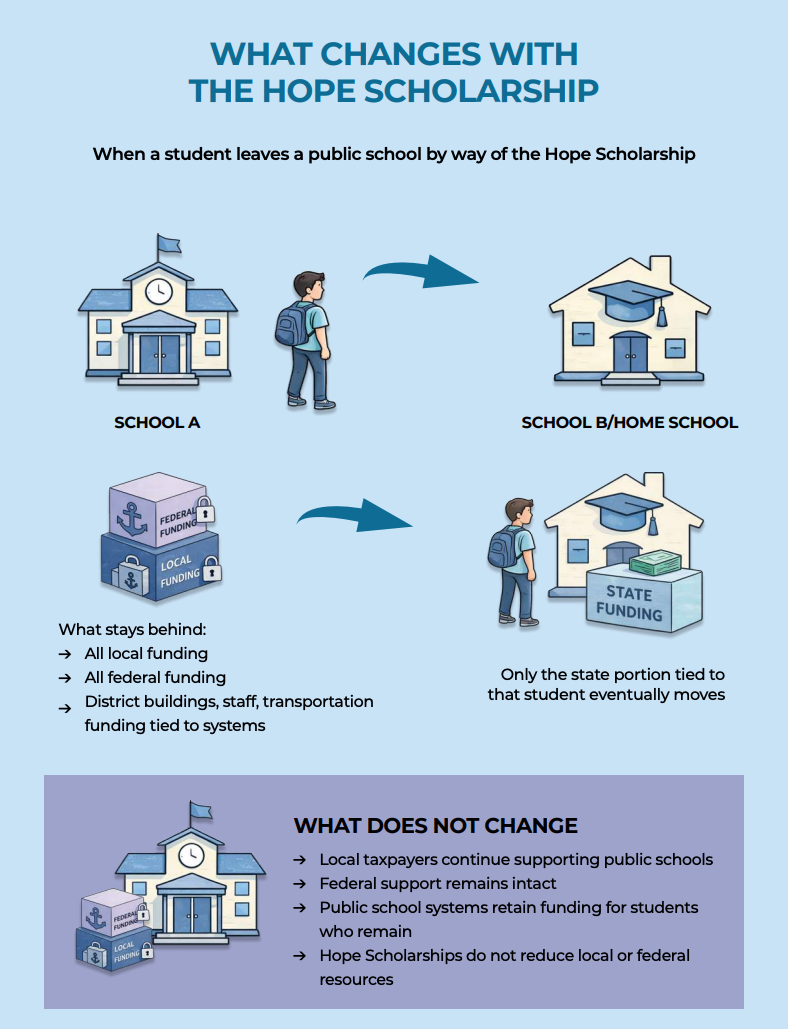
When a student leaves a public school and uses the Hope Scholarship, something does change. This is not a case where nothing happens financially. But it is also not a case where everything goes with the child.
What changes most directly is the state portion connected to that student’s enrollment.
That is the heart of the issue.
The state layer is the part of the funding system most closely tied to where a student is being educated. So if a student is no longer enrolled in the public system, that portion is the part most naturally connected to the student’s new educational setting. In that sense, the funding is reflecting a real-world change. The child is no longer there, and the student-connected state portion is no longer being directed there either.
But the rest of the funding picture does not move in the same way.
The local layer remains. The community’s property-tax support and levy support do not simply vanish because one family makes a different schooling decision. Those dollars remain part of the district’s support base.
The federal layer remains as well. Federal funding is typically connected to programs, requirements, and ongoing public-school responsibilities. It is broader than a simple individual transfer.
And beyond those things, the broader public-school system still exists. The district still has its buildings. It still has staff. It still has students to educate. It still has ongoing obligations and ongoing support structures.
This is what many people miss when they hear a large per-student spending number and assume all of it follows the child. A student’s departure does affect the funding picture, but it does not remove every dollar associated with that student from the public school system. The student-connected state share is the piece that changes most directly. The local and federal layers remain in place, along with the larger public-school structure that continues serving the students who stay.
That is why the debate needs clarity. The issue is not whether a school loses everything when a student leaves. It does not. The issue is whether the portion of funding most directly tied to a student’s enrollment should continue going to a school that student no longer attends.
What Does Not Change
Sometimes the most important part of an issue is not what changes, but what stays the same.
And in this case, quite a bit stays the same.
When a student uses the Hope Scholarship, local funding does not suddenly disappear. The district does not lose its local tax base because one student leaves. Those local dollars remain with the public school system.
Likewise, federal funding does not simply walk out the door with that child. Federal support is generally tied to programs, responsibilities, and student populations in ways that are much broader than a one-to-one personal transfer.
And the district itself does not stop being a public school system. It still has buildings to maintain, staff to oversee, students to teach, and ongoing obligations to meet.
That matters because much of the criticism surrounding education choice depends on making the change sound total. It depends on creating the impression that public schools are being emptied out dollar-for-dollar every time a family chooses another option. But that picture is overstated.
The reality is that significant portions of school support remain in place. The public system is not left with nothing. It retains major funding layers and major institutional supports. The Hope Scholarship affects part of the picture, not the whole picture.
That is why this conversation needs more precision and less panic.
If people continue talking as though one student’s departure removes every associated dollar from the district, they will keep misunderstanding what is actually happening. But if they begin to see the layered nature of school funding, the issue becomes much easier to understand. A student’s decision affects the student-connected state share, while other funding layers remain anchored to the public school system.
Conclusion
At its heart, this issue is about whether funding should reflect reality.
If a student is still being educated in a public school, the funding connected to that student should reflect that reality. If a student is no longer being educated there, then the student-connected portion of funding should reflect that reality too.
That does not mean public schools lose everything.
It means school funding has to be understood honestly. It is not one giant undivided sum. It is a layered system. The state portion is most directly tied to student enrollment and placement. The local portion remains with the district. The federal portion remains with the district. And broad “per student” averages should never be treated as though they are literal individual checks.
Once that is understood, the whole debate becomes easier to follow.
The Hope Scholarship is about recognizing that real students make real educational choices, and that part of the funding system should respond accordingly. Whether one supports that policy or not, the conversation should begin with a clear understanding of how the money actually works.

Cardinal Institute
The Cardinal Institute is dedicated to researching, developing, and communicating free-market economic public policies that promote liberty, prosperity, and personal responsibility in West Virginia. We believe these principles will help West Virginia thrive like never before – and achieve the economic turnaround that we like to call the “West Virginia Miracle.”