Turning Tax Dollars Into Educational Opportunity
How WV Accord Kids could help more families access Christian education
Every parent wants what is best for their child. For millions of families, that desire reaches beyond academics alone. They want a school where truth is not treated as something separate from learning, where the Bible is not merely tolerated but honored, and where teachers see every child as made in the image of God.
For many Christian families, this is the heart behind their desire for faith-based education. They are not simply looking for smaller classrooms, safer hallways, or stronger test scores, though those things matter. They are looking for an educational environment that reinforces what they are trying to teach at home: that God is Creator, that truth is real, that character matters, and that every subject belongs under the lordship of Christ.
Yet for too many families, that desire runs into a hard financial reality. Tuition, fees, books, supplies, and other educational costs can make a school that seems spiritually and academically ideal feel practically impossible. Parents may believe deeply in the value of Christian schooling and still find that the numbers do not add up.
That is why the Education Freedom Tax Credit is so significant.
When Conviction Meets Cost
Christian education has always involved sacrifice. Families make careful choices. Churches invest in schools. Teachers serve with conviction. Administrators work to keep tuition as affordable as possible while still providing a strong, faithful, and sustainable education.
But even with those sacrifices, many families still need help.
A family may be fully committed to Christian education and still struggle to afford it. A school may want to serve more children but lack the scholarship resources to make that possible. A donor may want to help but wonder whether a single contribution can make a meaningful difference.
The Education Freedom Tax Credit creates a new pathway for bringing those needs together.
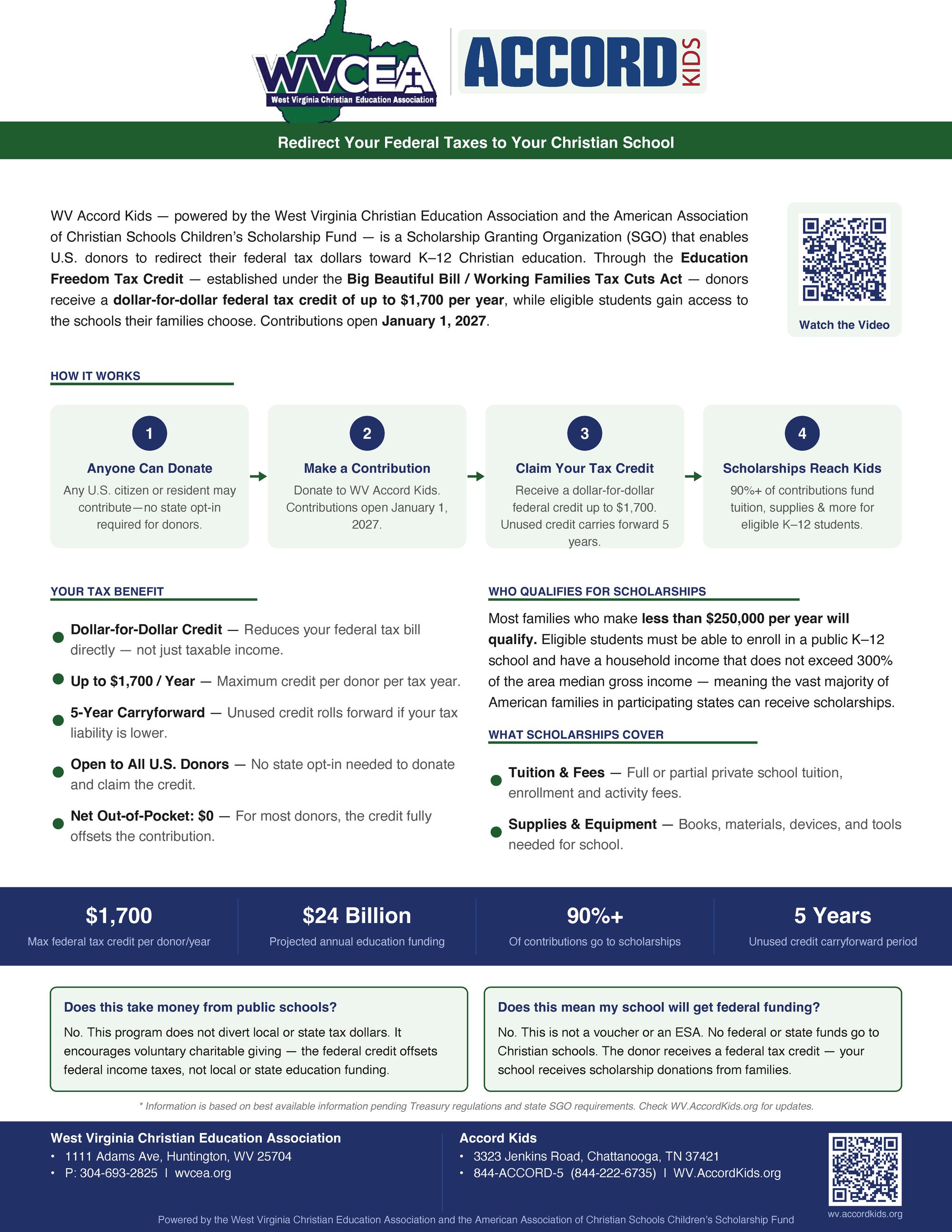
Beginning January 1, 2027, individual taxpayers may be able to claim a federal tax credit of up to $1,700 for certain cash contributions to qualifying Scholarship Granting Organizations, often called SGOs. Unlike a normal charitable deduction, which reduces taxable income, this credit reduces federal income tax owed dollar for dollar.
That distinction matters. A deduction may make charitable giving somewhat less costly. A credit, when properly claimed, directly reduces what a taxpayer owes. In plain language, a qualifying donor can give to an approved scholarship organization and receive a federal tax credit for that gift, up to the program’s annual limit.
This is not merely a technical tax provision. It has the potential to become a practical tool for helping children access the education their families choose.
WV Accord Kids and the Work Ahead
For West Virginia families and schools, WV Accord Kids represents a particularly important development.
WV Accord Kids is powered by the West Virginia Christian Education Association and the American Association of Christian Schools Children’s Scholarship Fund. It is designed to function as a Scholarship Granting Organization that receives contributions and directs scholarship funds toward eligible K–12 students seeking Christian education.
That connection matters. WVCEA already exists to serve, strengthen, and advocate for Christian education in West Virginia. Through WV Accord Kids, the association is positioned not merely to speak about the need for educational freedom, but to help build a scholarship pathway that can serve real students, real families, and real schools.
The basic process is simple. A donor makes a qualifying contribution to WV Accord Kids. The donor then claims the appropriate federal tax credit when filing taxes, subject to the rules and limits of the program. WV Accord Kids uses the scholarship funds to help eligible K–12 students with qualified educational expenses.
According to the WV Accord Kids summary, more than 90 percent of contributions are intended to go toward scholarships, helping cover tuition, fees, supplies, equipment, books, materials, devices, and other school-related needs.
For donors, the appeal is clear. They are not merely making a general charitable gift. They are helping place Christian education within reach for children and families. For families, the impact could be deeply personal. A scholarship may be the difference between wanting Christian education and actually being able to pursue it.
More Than a Deduction
The most important financial feature of the program is the dollar-for-dollar nature of the credit.
A charitable deduction lowers taxable income. A tax credit lowers the tax bill itself. The IRS describes the Federal Scholarship Tax Credit as a nonrefundable federal credit for certain cash contributions, limited to $1,700 per taxpayer.
For many donors, that means the net cost of giving may be dramatically reduced or even fully offset, depending on their federal tax liability and personal tax situation. The WV Accord Kids material describes this as a “net out-of-pocket” opportunity of $0 for many donors when the credit fully offsets the contribution.
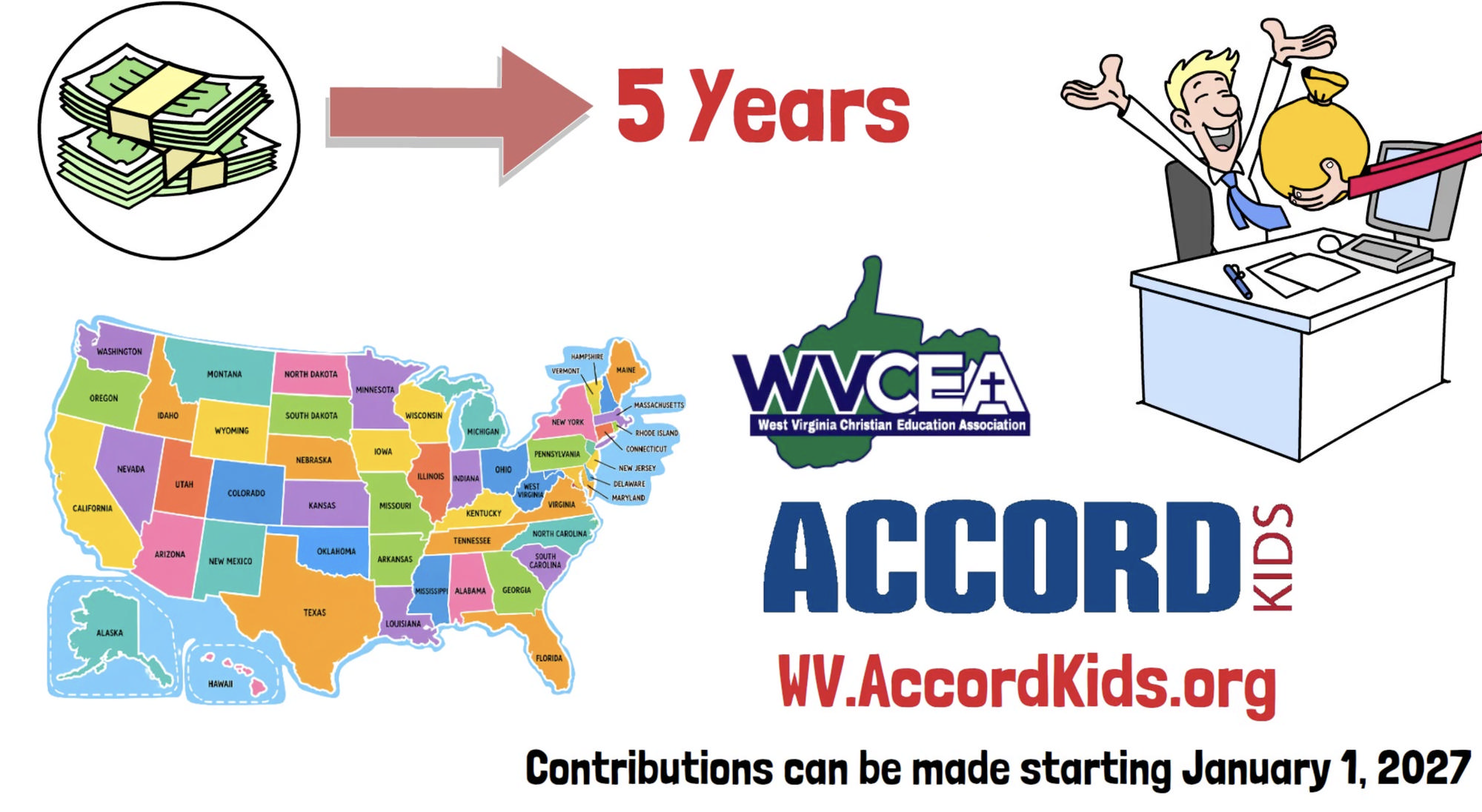
There is also a carryforward provision. If a donor cannot use the full credit in a single year, unused credit may be carried forward for up to five years.
As with any tax-related matter, donors should consult their own tax advisor and watch for final Treasury regulations and state-level SGO requirements. The WV Accord Kids material itself notes that its information is based on the best available information pending Treasury regulations and state SGO requirements.
That caution is important, not because the opportunity is uncertain in its basic direction, but because implementation details matter. Families, schools, and donors will need reliable guidance as the 2027 launch approaches.
Who the Scholarships Are Designed to Help
The Education Freedom Tax Credit is aimed at expanding educational opportunity for K–12 students. Under current federal descriptions, SGOs use contributions to provide scholarships for children to attend a school of choice or access other eligible education-related services and products.
The WV Accord Kids material explains that eligible students must be able to enroll in a public K–12 school and must come from a household with income not exceeding 300 percent of the area median gross income. It summarizes the practical effect by noting that most families making less than $250,000 per year will qualify.
That is an important point. This is not a program designed only for the very poorest families, though it may certainly help them. It has the potential to serve a broad range of working and middle-income families who care deeply about education but face real financial limits.
The scholarship funds may help cover tuition and fees, but the scope is broader than tuition alone. The WV Accord Kids summary includes school supplies, equipment, books, materials, devices, and other tools needed for school.
For a family trying to make Christian education work, those additional costs matter. The tuition bill may be the largest expense, but it is rarely the only one. Enrollment fees, curriculum costs, technology, supplies, and activity fees can add up quickly. A scholarship that recognizes those realities can help make the entire educational choice more sustainable.
A Christian Education Issue, Not Just a Tax Issue
For WVCEA, this is not merely a policy update. It is a Christian education issue.
A school shapes more than a child’s schedule. It shapes assumptions, affections, habits, friendships, worldview, and imagination. It teaches students not only how to read, write, calculate, and reason, but also what is true, what is good, what is beautiful, and what kind of person they should become.
That is why Christian education matters so deeply to the families and schools WVCEA serves.
Parents who choose Christian education are often seeking a school that strengthens the work of discipleship already happening in the home and church. They want their children to learn in an environment where academic excellence and biblical truth are not treated as competitors. They want teachers who see students not as data points or economic units, but as souls created in the image of God.
No scholarship program can replace faithful parenting. No tax credit can guarantee spiritual fruit. No policy, however wise, can substitute for the daily work of teaching, discipling, correcting, encouraging, and loving children well.
But wise policy can remove unnecessary barriers. It can help families pursue the kind of education they believe is best for their children. It can strengthen schools that are serving students with conviction, sacrifice, and care. It can allow donors to support Christian education in a way that is both financially meaningful and missionally clear.
What About Public School Funding?
One common concern with any school choice program is whether it takes money away from public schools.
The WV Accord Kids material answers that concern directly: this program does not divert local or state tax dollars from public education. It is based on voluntary charitable giving, with the federal credit offsetting federal income taxes rather than local or state education funding.
That distinction is important. WV Accord Kids is not presented as a voucher program or an Education Savings Account. According to its own summary, no federal or state funds go directly to Christian schools through this structure. Instead, donors receive a federal tax credit, and scholarship organizations provide scholarship assistance to families.
That does not mean there will be no public debate. Educational freedom is always a contested issue. But the structure of the program should be described accurately. It encourages voluntary giving to scholarship organizations so that families can access educational options.
The Importance of Participation and Preparation
There is one implementation detail that schools and families should watch carefully: state participation and SGO approval.
The IRS states that for contributions to an SGO to be eligible for the federal credit, the SGO must be listed by a participating state for the applicable calendar year. A state or D.C. must choose to participate and provide a list of SGOs before taxpayers can donate to an SGO in that state and claim the credit.
That means the opportunity is national in scope, but it still depends on proper implementation. Donors may be able to live anywhere in the United States, but the contribution must be made to a qualifying SGO connected to the program’s requirements. Schools, families, and donors should follow official updates from WV Accord Kids and WVCEA as regulations and state processes are finalized.
The good news is that preparation can begin now.
Contributions open January 1, 2027, but schools do not have to wait until then to educate families and donors. Churches, school boards, administrators, pastors, and supporters of Christian education can begin explaining the opportunity, answering common questions, and helping people understand how tax-credit scholarships may serve children in their communities.
A Doorway for Families
The Education Freedom Tax Credit is not just a tax provision. For many families, it may become a doorway.
It may open a doorway for parents who have long desired Christian education but assumed it was financially impossible. It may open a doorway for schools to serve more students without placing the full burden on tuition-paying families. It may open a doorway for donors who want to support Christian education in a way that is direct, practical, and financially wise.
For WVCEA, WV Accord Kids represents a significant opportunity to advance the cause of Christian education in West Virginia and beyond. It connects public policy, charitable giving, family choice, and school access in a way that could bring tangible help to thousands of students.
The heart of the matter is simple: children need an education that forms them well. Families need real options. Christian schools need sustainable scholarship support. Donors need clear pathways for generosity.
WV Accord Kids brings those needs together.
And beginning in 2027, many taxpayers may have the opportunity to redirect federal tax dollars toward something of eternal significance: helping children receive an education shaped by truth, purpose, and faith.

Mike Wilson
Mr. Mike Wilson, the WVCEA Legislative Liason, has a rich educational, governmental, and experiential background that he brings to his role with WVCEA. Mike monitors legislation in Charleston and works to preserve freedoms for our Christian schools, churches, and families