
Homeschool Shop Class
The Garage Workshop
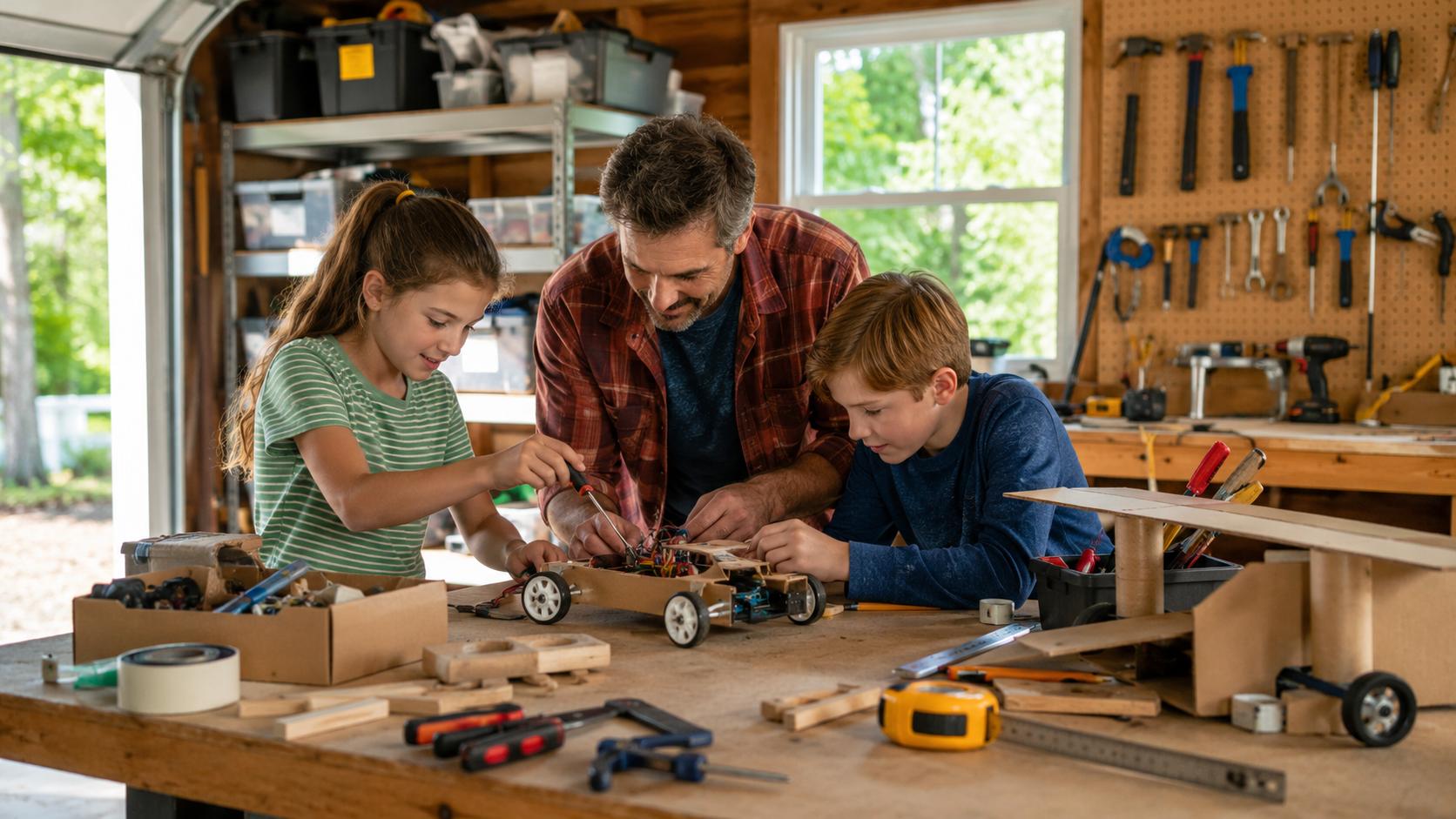
The garage workshop may be where you keep the bikes, tools, and boxes you haven’t gotten around to organizing yet, but it may also be one of the most exciting (not) classrooms in your homeschool!
One of the greatest advantages of homeschooling is being able to follow an idea wherever it takes you. A simple question about how something works can become an afternoon of analyzing, building, testing, and re-testing. The garage is a natural place for that kind of hands-on learning—a place where kids can get their hands on real-world tools and materials and discover that STEM isn’t just something they read about in a textbook. It’s something they can do on their own.
You don’t need expensive materials, a dedicated workshop, or special equipment to get started. Sometimes all it takes is a cardboard box, some household supplies, and an object that needs fixing.
Building, testing, and solving problems teaches us something important: It’s okay when the first idea doesn’t work. A prototype may fall apart. A design may not move the way you intended. A robot may refuse to cooperate. A household invention may need a few—or many—adjustments before it functions.
That’s not failure. That’s the process.
STEM encourages children to think, “What happened?” “Why didn’t this work?” “What can I change?” Those questions build perseverance, creativity, problem-solving skills, and the confidence to try again.
Machines and Robotics
The garage workshop is a natural place to explore STEM because it gives kids the opportunity to build, test, and solve real problems. You can take that learning even farther with robotics, combining engineering, technology, programming, and problem-solving into one hands-on activity. HEAV’s Teaching Robotics offers ideas for introducing robotics into your homeschool and encouraging children to learn through building and experimentation.
You can also find STEM hiding in some of the simplest things in your home. A cheese grater, a screwdriver, a pair of scissors, a fan, or even a doorknob can demonstrate the principles behind simple machines. HEAV’s Homeschool STEM: Simple Machines offers some unique, hands-on ways to explore the science of science of six simple machines and learn how they make life easier.
And what happens when your children begin to realize that their ideas can solve problems for other people? STEM skills can build the foundation for creativity and entrepreneurship. HEAV’s Entrepreneurship for Kids introduces young people to the basics of entrepreneurship and encourages them to think creatively about ideas, products, and services.
Try It This Week! Homeschool Challenge
Simple Machine Hunt
You don’t need a toolbox full of equipment to find STEM learning at home. Simple machines are everywhere!
Take a tour of your house, yard, and garage and see how many examples you can find of the six simple machines: lever, inclined plane, wheel and axle, pulley, wedge, and screw.
Doorstops and kitchen knives are both examples of wedges. Pliers are levers. Lightbulbs and jar lids utilize screws. Staircases are an inclined plane. Window blinds use pulleys. Doorknobs and rolling chairs demonstrate a wheel and axle.
Challenge your family to find as many examples as they can. Then, talk about them.
What is the simple machine? And how does it make work easier?
See if you can find something that uses more than one simple machine. You may be surprised by how much engineering is hiding in the ordinary things you use every day.
Those same problem-solving skills can carry into entrepreneurship. When children learn to recognize problems and think of solutions, they’re learning to think like innovators, engineers, and entrepreneurs.
Homeschooling allows room for them to tinker, take things apart, build something new, break things, and occasionally make a glorious mess as they figure things out. So clear some space, let go of the materials, and see what your children can build. You never know what might come out of the garage.
Learning happens everywhere—even among the tools, old cardboard boxes, and broken objects.
*This article was originally posted on the Home Educators Association of Virginia (HEAV) blog. Used by permission. https://heav.org/not-back-to-school-garage-workshop/

Megan Mora Fuentes
A homeschool graduate, Megan earned her associate degree while in high school. She has worked as an office manager for eight years. In her spare time, Megan enjoys kayaking, writing, and baking cookies for anyone who will eat them. She and her husband live in her hometown of Winchester.