Well Done Good and Faithful Servants !!
Faith tops the reasons families chose the Hope Scholarship
For the first time since the Hope Scholarship launched, West Virginia has hard data on how the families who actually use the program feel about it. The answer is about as close to unanimous as a survey gets.
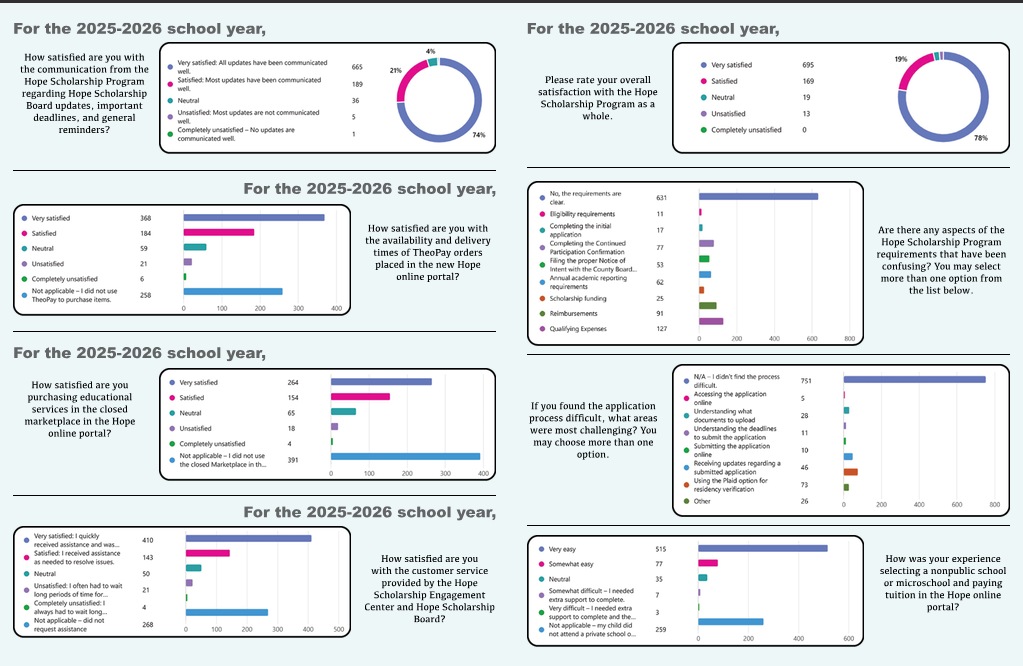
Of 896 families who responded to the State Treasurer's Office Parent Satisfaction Survey for the 2025-2026 school year, 864 said they were satisfied or very satisfied with the Hope Scholarship Program as a whole. That is 96.4%. Not a single respondent chose "completely unsatisfied." Only 13 families, fewer than 2%, expressed any dissatisfaction at all.
The results, released this month, arrive at a pointed moment. On September 4, 11 parents in Mingo County filed suit in Kanawha County Circuit Court asking a judge to halt payments to new families who became eligible for Hope this year under the universal expansion the Legislature approved and the governor signed. His Good News will address that lawsuit tomorrow with a special article that looks at this from three perspectives: (a) the legislators who led the creation of Hope, (b) the person who manages Hope and (c) the homeschool mom who took it Hope to the West Virginia Supreme Court and won. Tomorrow's article will also offer a fourth perspective and a potential solution proposed by West Virginia Christian Education Association.
Today's artlcle is to tell you about the most important perspective - the parents who actually use Hope.
What the families said
The survey ran for 71 days and asked 13 questions covering communication, customer service, the online purchasing portal, program requirements, the application process, spending priorities, and the reasons families chose Hope in the first place. The Treasurer's Office received 896 responses, along with 887 written comments.
On communication about board updates, deadlines, and reminders, 854 of 896 families, or 95%, said they were satisfied or very satisfied. Among the 628 families who contacted the Hope Scholarship Engagement Center or the Hope Board for help, 88% said their issue was resolved to their satisfaction, with 410 of them saying they "quickly received assistance." Among the 637 families who used the Hope online portal to select a private school or microschool and pay tuition, 93% described the experience as very easy or somewhat easy.
Program requirements, often cited by critics as a barrier for families, drew a clear verdict. Asked whether any part of the requirements had been confusing, 631 families, more than 70%, answered simply, "No, the requirements are clear." Asked which parts of the application were most challenging, 751 families, nearly 84%, said they did not find the process difficult at all. The single most-cited hurdle was the Plaid option for residency verification, named by 73 families, a fixable technical detail.
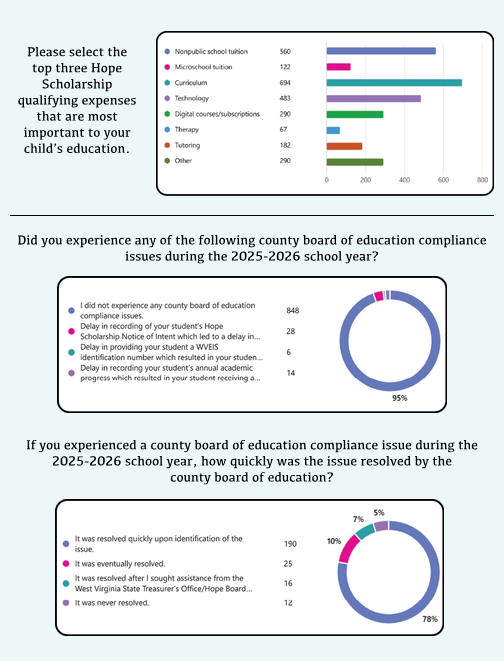
The relationship between Hope families and their county boards of education, another frequent flashpoint in public debate, also appears far healthier than the rhetoric suggests. Nearly 95% of families, 848 of 896, told the survey they had no county compliance issues of any kind during the school year.
Where the money goes
Asked to name the three qualifying expenses most important to their child's education, families put curriculum at the top with 694 selections, followed by nonpublic school tuition at 560 and technology at 483. Digital courses and subscriptions drew 290, tutoring 182, and microschool tuition 122.
That mix tells its own story. Hope functions as far more than a tuition voucher. For a large share of West Virginia families it is the means by which they buy the books, software, and tools to build an education at home or in a small learning community. The scholarship amount for the current year is $5,435.62, according to program figures reported by WBOY.
Why they chose Hope: faith, by a wide margin
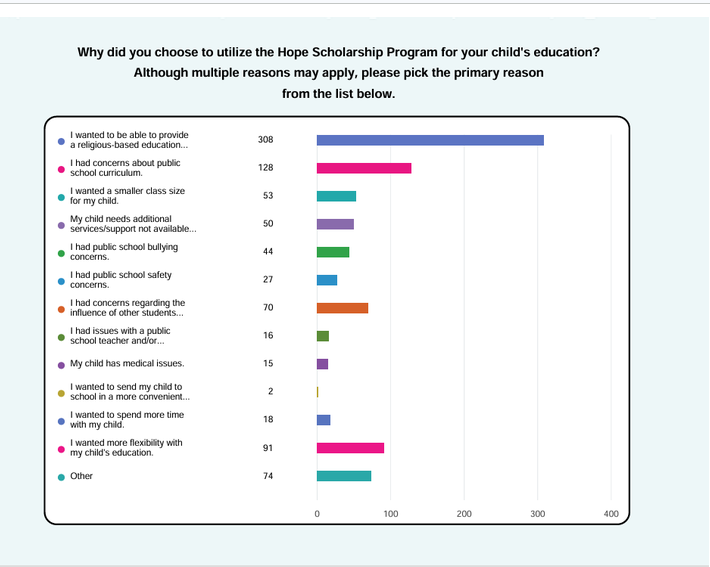
The survey's most revealing question asked families to name the single primary reason they chose the Hope Scholarship. The survey offered 13 options, including class size, bullying, safety, special needs, medical issues, scheduling, and flexibility.
One answer stood far above the rest. Of the 896 families, 308, more than one in three, said they chose Hope because they "wanted to be able to provide a religious-based education." The next most common reason, concerns about public school curriculum, drew 128. Faith outpolled the runner-up by more than double and exceeded the next three reasons combined.
The Treasurer's Office itself flagged this as the key takeaway from the survey. In a statement to His Good News, the office said that "the number one reason families chose the Hope Scholarship Program to educate their child was because they wanted to be able to provide a religious-based education."
This matters for more than sociology. It places Hope squarely within a line of religious liberty rulings from the United States Supreme Court. In Espinoza v. Montana Department of Revenue (2020), the Court held that a state which creates a scholarship program cannot bar families from using it at religious schools because of their religious character. In Carson v. Makin (2022), the Court extended that principle to the religious use of the funds. The Constitution does not permit West Virginia, or any state, to tell a Christian family that public benefits are available to everyone except them. Hope honors that principle, and a third of its families are relying on it.
Add the 128 families with curriculum concerns, the 70 worried about the influence of other students, and the 91 who wanted more flexibility, and the picture is of parents making deliberate, values-driven decisions about the formation of their children.
Lawmakers weigh in
His Good News has asked every member of the West Virginia Legislature whether they support the Hope Scholarship in its current form. Among the first to respond was Senator Chris Rose, R-Monongalia, chairman of the Senate Energy, Industry, and Mining Committee.
"Yes, I support the Hope Scholarship in its current form," Rose wrote in a September 8 response to His Good News. "I believe parents, not government bureaucrats, know what is best for their children. West Virginia families should have the freedom to choose the educational path that works best for their child, whether that means public school, private school, Christian school, or homeschooling."
"The Hope Scholarship was an important step toward giving parents that freedom," he added, "and I support maintaining it and building on it so that every West Virginia family who wants school choice has that opportunity."
The verdict is already in
Fully 887 families used the survey's final question, an open comment box, to say whatever they wanted about the program. The most recent entries read like a chorus. "We have had a great experience from the beginning," wrote one parent. "Our family has had no issues with Hope Scholarship," wrote another. A third simply typed, "N/A - very satisfied with the current program."
That is what a working program sounds like so to all of the Legislators, Parents, Vendors, the West Virginia Treasurer's Office and the West Virginia Governor.
"Well Done Good and Faithful Servants"
Five years ago, Hope's critics predicted chaos: confused parents, broken systems, families abandoned by a program too new to serve them. Nearly 900 families have now answered those predictions with the plainest possible response: 96% are satisfied, 70% find the rules clear, and 95% had no trouble with their county. A third of them are raising their children in the faith they chose, using a freedom the Supreme Court has said belongs to them.
The Treasurer's Office says Treasure Pack is "ecstatic" about the results and that his office is not done improving the program. Families with suggestions can reach the Hope Scholarship Program at [email protected]
To download the survey results click here
Sources: West Virginia State Treasurer's Office, Hope Parent Satisfaction Survey for the 2025-2026 school year, results dated July 14, 2026, and accompanying summary notes; statements from the Treasurer's Office to His Good News; written response from Sen. Chris Rose to His Good News, Sept. 8, 2026;

HGN Staff
His Good News magazine seeks to unite and empower parents, educators, legislators, and voters in West Virginia to support and advance Christian education, religious freedom, and conservative values. By fostering a strong Jesus-based foundation within our communities, we can influence legislation, protect religious freedoms, and ensure that our children receive a quality Christian education.