Blast Off!
Rocket Science for Your Homeschool

Few things capture our imagination like rockets. The countdown, the roar of liftoff, and the sight of something soaring skyward naturally spark curiosity about science and space. This March offers a perfect opportunity to explore rocket science in your homeschool as we mark the 100th anniversary of the first successful liquid-fueled rocket launch.
On March 16, 1926, physicist Robert H. Goddard launched an experimental rocket in a snowy field in Auburn, Massachusetts. The flight lasted just two and a half seconds and reached about 41 feet in height, but that small launch helped ignite the era of modern rocketry.
Before Goddard’s work, most rockets relied on solid fuels similar to fireworks. Goddard believed liquid fuels could produce greater power and control. His experiment proved the concept, laying the foundation for technologies that would eventually send satellites into orbit and astronauts to the moon.
The Smithsonian National Air and Space Museum preserves one of Goddard’s early rocket designs, showing the evolution from his first experiments to advanced rockets. Science Learning Hub’s Brief History of Rockets Timeline traces developments from ancient fire arrows to today’s space missions.
Stories like Goddard’s also invite meaningful discussion in your homeschool:
- Why are groundbreaking scientific ideas sometimes dismissed at first?
- How do small experiments lead to major technological breakthroughs?
- What role do perseverance and curiosity play in scientific discovery?
Rocket Science in Action
Rockets demonstrate one of the most important principles in physics: Newton’s Third Law of Motion—for every action, there is an equal and opposite reaction. When fuel burns inside a rocket engine, gases rush downward through the nozzle. The rocket moves upward in response. Even young students can observe this principle through simple demonstrations.
A classic activity from the NASA Jet Propulsion Laboratory uses a balloon to simulate rocket propulsion. By releasing air through the balloon along a string, students can watch Newton’s Third Law in action as the balloon propels forward like a rocket. This simple experiment turns abstract physics concepts into something students can see and test themselves.
Rocket Science in Your Homeschool
Ready to take your rocket science studies a step further? Consider organizing a small rocket launch or challenge with friends or a homeschool co-op.
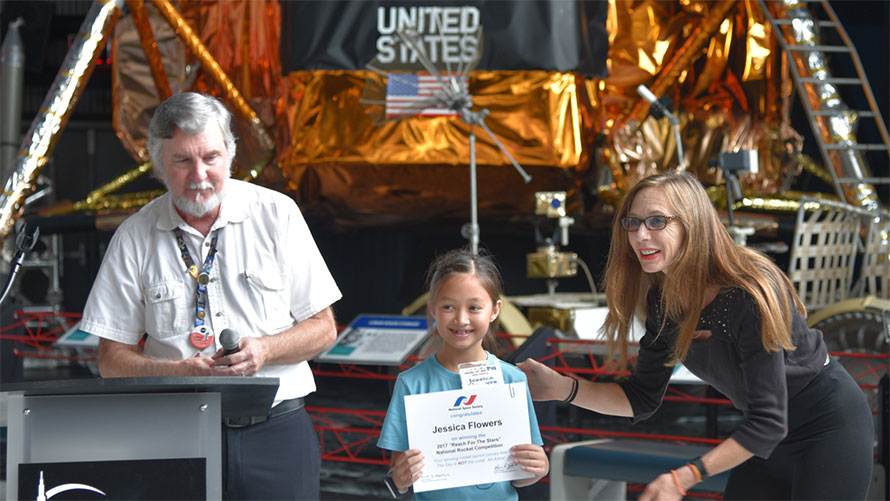
The Reach for the Stars National Rocket Competition encourages students ages 10–18 to design, build, and launch their own model rockets. In the competition, rockets are launched and guided back to Earth by parachute, aiming to land as close as possible to a designated target.
What makes this challenge especially homeschool-friendly is that local groups can host their own launch events. Families or co-ops organize the activity, record the results, and submit scores as part of the national competition. Even if you choose not to host a full competition, building and launching a model rocket can introduce students to real-world concepts like aerodynamics, engineering design, and problem-solving.
Rocket science reminds us that even the biggest technological achievements often begin with small experiments and bold ideas. A rocket that rose just 41 feet in 1926 eventually helped inspire missions that traveled hundreds of thousands of miles to the moon and beyond, making this centennial a perfect reminder that curiosity can launch incredible journeys.
*This article was originally posted on the Home Educators Association of Virginia (HEAV) blog. Used by permission. https://heav.org/rocket-science-homeschool/

Megan Mora Fuentes
A homeschool graduate, Megan earned her associate degree while in high school. She has worked as an office manager for eight years. In her spare time, Megan enjoys kayaking, writing, and baking cookies for anyone who will eat them. She and her husband live in her hometown of Winchester.