Families First in Education
House Education Funding Bill Signals a Larger Debate Over Educational Freedom
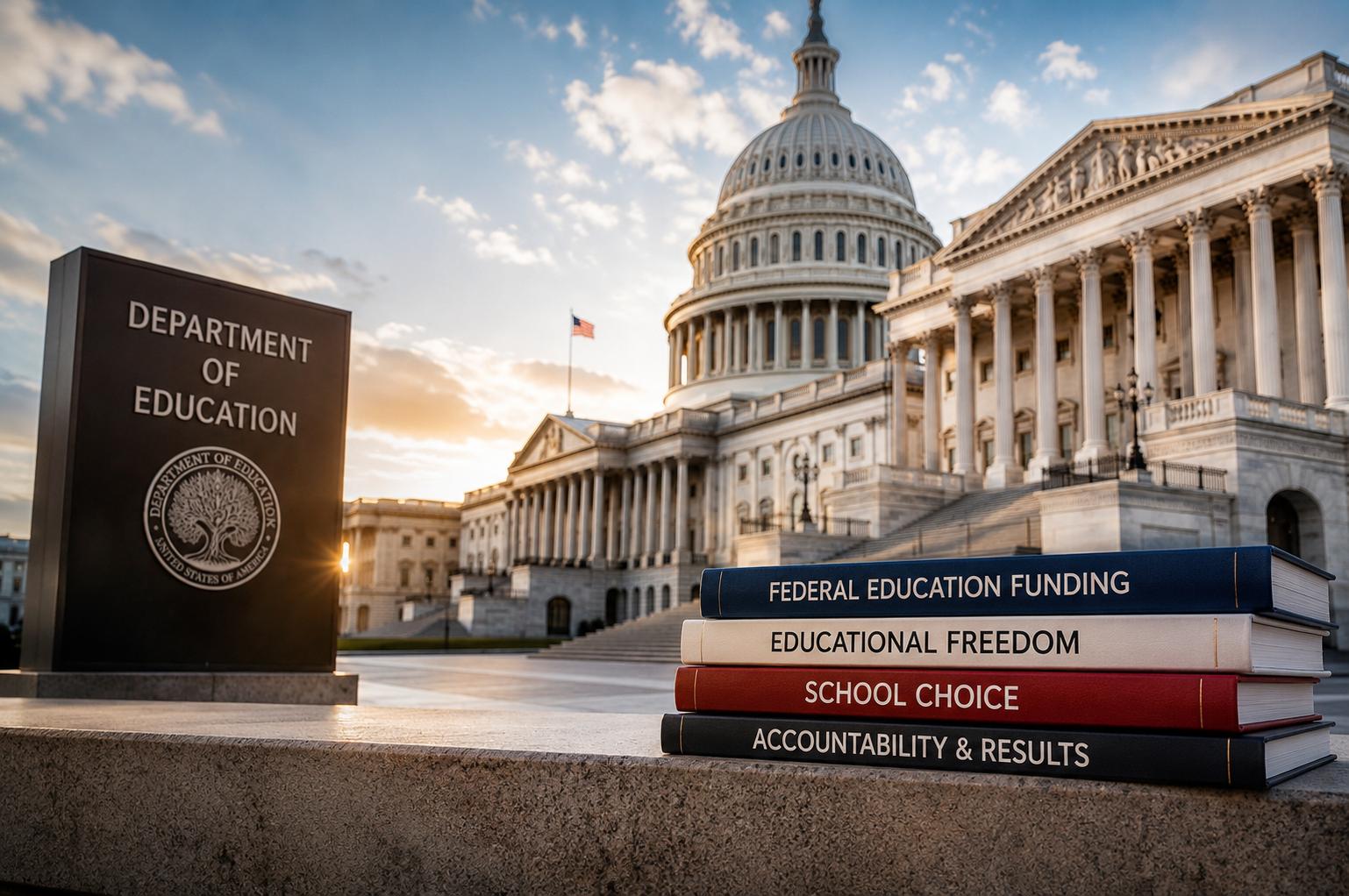
Recently, the House Appropriations Labor, Health and Human Services, Education, and Related Agencies Subcommittee advanced a federal funding bill by an 11-7 party-line vote. The full House Appropriations Committee later advanced the bill by a vote of 34-28, sending it to the full House for further consideration.
The bill would fund the U.S. Department of Education at $70.7 billion, about $8 billion below current funding levels. That represents a 10 percent decrease from the prior year. Among the largest proposed reductions is a roughly $2 billion cut to Title I, bringing that program to about $16.5 billion. The bill would also eliminate the Office of English Language Acquisition, which supports English learners and language instruction programs.
At the same time, the bill does not simply cut across the board. It increases funding for charter schools by $60 million, career and technical education state grants by $10 million, IDEA funding by $46 million, and the Innovative Approaches to Literacy program by $10 million. The bill would also reinstate, with bipartisan support, the National Reading Panel to evaluate reading instruction strategies and report its findings to Congress.
The bill also includes several policy provisions that go beyond ordinary budget math. It defends a biological definition of sex in athletic competition and prohibits federal funding from going to institutions that allow males to compete in athletic programs designated for women or girls. It prohibits funding from going to colleges that recognize student groups that have provided vocal or material support to designated foreign terrorist organizations or received support from such organizations. It also withholds funding from public colleges that deny religious student groups equal rights, benefits, or privileges because of their religious beliefs, practices, speech, leadership standards, or standards of conduct.
The legislation will almost certainly change before it becomes law. The full House has not completed the process, and the Senate has not yet released its own proposed budget bill for 2027. Still, the proposal matters because it reveals a deeper national debate about who should direct education, who should fund it, and what kinds of educational institutions should be encouraged.
For Christian schools, private schools, homeschools, and advocates of educational freedom, this bill should not be reduced to a simple celebration of lower federal spending. It is more significant than that, and more complicated. A smaller federal Department of Education does not automatically strengthen families or improve schools. A budget cut, by itself, does not create educational liberty. But the priorities inside this bill do suggest a shift away from assuming that Washington should be the central manager of American education.
That shift matters.
For decades, many families have felt that educational policy treated the public school system as the default and everything else as an exception. Christian schools were tolerated, homeschools were regulated or questioned, and private education was often viewed as a privilege for families who could afford it. But millions of parents do not see education that way. They believe they carry the primary responsibility for the formation of their children. Schools, co-ops, tutors, churches, online programs, and curriculum providers may all serve as partners, but they do not replace parental stewardship.
A healthier vision of education recognizes that children are not standardized units in a federal system. They are persons. They have souls, gifts, weaknesses, family contexts, learning needs, and moral formation. No single school model can serve every child equally well. Public schools can serve many children faithfully, and many Christian teachers work in them with excellence and conviction. But public schools cannot be expected to meet every academic, spiritual, relational, and moral need of every family.
That is why educational freedom matters.

For Christian schools, private schools, homeschools, and advocates of educational freedom, this bill should not be reduced to a simple celebration of lower federal spending. It is more significant than that, and more complicated. A smaller federal Department of Education does not automatically strengthen families or improve schools. A budget cut, by itself, does not create educational liberty. But the priorities inside this bill do suggest a shift away from assuming that Washington should be the central manager of American education.
That shift matters.
For decades, many families have felt that educational policy treated the public school system as the default and everything else as an exception. Christian schools were tolerated, homeschools were regulated or questioned, and private education was often viewed as a privilege for families who could afford it. But millions of parents do not see education that way. They believe they carry the primary responsibility for the formation of their children. Schools, co-ops, tutors, churches, online programs, and curriculum providers may all serve as partners, but they do not replace parental stewardship.
A healthier vision of education recognizes that children are not standardized units in a federal system. They are persons. They have souls, gifts, weaknesses, family contexts, learning needs, and moral formation. No single school model can serve every child equally well. Public schools can serve many children faithfully, and many Christian teachers work in them with excellence and conviction. But public schools cannot be expected to meet every academic, spiritual, relational, and moral need of every family.
That is why educational freedom matters.
For Christian schools, the bill’s emphasis on religious liberty is especially important. The higher education provisions concerning religious student groups may not directly govern every K-12 Christian school, but they reflect a larger principle: religious organizations should not be penalized for being religious. A Christian group that requires Christian leadership is not discriminating against others by maintaining its identity. It is living consistently with its mission. Christian schools should be allowed to do the same.
This matters because mission drift is one of the greatest dangers facing Christian education. If Christian schools receive more attention in a school choice era, they must not respond by becoming generic private schools with Bible classes attached. They need strong academics, safe classrooms, wise discipline, sound governance, and clear policies. But above all, they need courage to remain distinctly Christian. Educational freedom is not merely the freedom to operate a school. It is the freedom to form students according to truth.
For private schools more broadly, the bill points to another reality: families want options. Some families choose private education for religious reasons. Others choose it because of classroom size, academic rigor, school culture, specialized instruction, safety concerns, or a child’s particular needs. Private schools should see this moment as an opportunity, but also as a responsibility. If more families seek alternatives, private schools will need to think carefully about affordability, admissions, scholarships, special education capacity, teacher quality, and institutional transparency.
For homeschool families, the larger movement toward educational freedom is both encouraging and clarifying. Homeschooling should not be treated as a fringe option or a last resort. For many families, it is a thoughtful and deeply fruitful way of life. But freedom does not remove responsibility. It increases it. Homeschool families need good curriculum, healthy rhythms, accountability, community, co-ops, testing options, transcript help, and encouragement. A freer education landscape should not leave families isolated. It should strengthen networks that help parents teach well and persevere.
The proposed reinstatement of the National Reading Panel also deserves attention. Reading is not a partisan issue. A child who cannot read well will struggle across every subject and in nearly every kind of school. Christian schools, private schools, homeschools, charter schools, and public schools should all care about evidence-based reading instruction. If the federal government has any constructive role in education, helping recover clarity about literacy is one of the better places to focus. Strong reading opens the door to Scripture, history, literature, science, citizenship, and lifelong learning.
Of course, critics of the bill will raise serious concerns. A major reduction to Title I funding could affect schools serving low-income students. Eliminating the Office of English Language Acquisition will concern those who serve English learners. Those concerns should not be dismissed lightly. Educational freedom should never become an excuse to ignore vulnerable children. Christians, in particular, should resist the temptation to think only about the families who already have options.
But there is another danger as well. We should not assume that federal funding is the same thing as educational care. Money matters, but so do authority, accountability, mission, truth, family, and local wisdom. A system can be well-funded and still fail children. A smaller institution can be less expensive and more faithful. A homeschool can be simple and rich. A Christian school can be modest and excellent. A public school can be under pressure and still filled with teachers who love their students.
Educational freedom is not about abandoning the public square. It is about admitting that the public square is healthier when families, churches, schools, and local communities all have room to serve. It is not anti-public school to say that parents should have more than one path. It is not anti-teacher to say that a child may need a different setting. It is not anti-government to say that government has limits.
The House funding bill is not final, and it should be watched carefully as it moves through Congress. But even in its current form, it highlights the larger question before the country: Will education remain primarily a centralized system managed from above, or will policy increasingly recognize the God-given responsibility of parents and the real diversity of children?
For Christian schools, private schools, homeschools, and advocates of educational freedom, the answer should be clear. We should want an education system that strengthens families, protects conscience, honors religious liberty, encourages academic excellence, and makes room for different kinds of schools to serve different kinds of children.
That does not mean every proposal is perfect. It does mean the conversation is moving in an important direction. Families need freedom. Schools need clarity. Children need formation. And education policy should serve all three.